Ch.9 - Alkynes
Wade - Organic Chemistry 9th Edition
Wade9th EditionOrganic ChemistryISBN: 9780135213728Non è quello che usi tu?Cambia libro di testo
Capitolo 9, Problema 26j,k

Write structural formulas for the following compounds (includes both old- and new-style names).
(j) vinylacetylene
(k) (S)-3-methyl-1-penten-4-yne

Guida verificata passo dopo passo
1
Step 1: Understand the structure of vinylacetylene. The name 'vinylacetylene' suggests a compound containing both a vinyl group (-CH=CH2) and an acetylene group (-C≡CH). These groups are connected to form a single molecule.
Step 2: Draw the structure of vinylacetylene. Place the vinyl group (-CH=CH2) on one end and the acetylene group (-C≡CH) on the other, ensuring they are directly connected by a single bond. The resulting structure is CH2=CH-C≡CH.
Step 3: For (S)-3-methyl-1-penten-4-yne, break down the name. The '1-penten-4-yne' indicates a five-carbon chain with a double bond at position 1 and a triple bond at position 4. The '3-methyl' indicates a methyl group (-CH3) attached to the third carbon. The '(S)' specifies the stereochemistry of the chiral center at carbon 3.
Step 4: Draw the carbon chain for 1-penten-4-yne. Start with a five-carbon chain, placing a double bond between carbons 1 and 2, and a triple bond between carbons 4 and 5. Add the methyl group (-CH3) to carbon 3.
Step 5: Assign the (S) configuration to the chiral center at carbon 3. Use the Cahn-Ingold-Prelog priority rules to determine the priorities of the groups attached to carbon 3. Arrange the groups in 3D space so that the lowest priority group is pointing away from you, and verify that the remaining groups follow a counterclockwise order for the (S) configuration.

Risposta video verificata per un problema simile:

Questa soluzione video è stata consigliata dai nostri tutor come utile per risolvere questo problema.
Durata del video:
6m

Concetti chiave

Ecco i concetti essenziali che devi comprendere per rispondere correttamente alla domanda.

Structural Formulas

Structural formulas represent the arrangement of atoms within a molecule, illustrating how atoms are bonded together. They provide insight into the molecular geometry and functional groups present, which are crucial for understanding the compound's reactivity and properties. Different styles, such as condensed or skeletal formulas, can be used to convey this information succinctly.
Video consigliato:
05:21
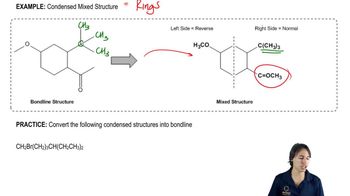
How to draw condensed mixed structures.

Nomenclature in Organic Chemistry

Nomenclature refers to the systematic naming of organic compounds based on established rules, such as those set by the International Union of Pure and Applied Chemistry (IUPAC). Understanding both old-style and new-style names is essential for accurately identifying compounds and their structures. For example, 'vinylacetylene' and '(S)-3-methyl-1-penten-4-yne' illustrate how stereochemistry and functional groups are incorporated into names.
Video consigliato:
00:56
What is an organic molecule?

Stereochemistry

Stereochemistry is the study of the spatial arrangement of atoms in molecules and how this affects their chemical behavior. It is particularly important in compounds with chiral centers, as in the case of (S)-3-methyl-1-penten-4-yne, where the 'S' designation indicates a specific three-dimensional arrangement. Understanding stereochemistry is crucial for predicting the reactivity and interactions of organic molecules.
Video consigliato:
Percorso guidato
1:38
Polymer Stereochemistry Concept 1