Benzyl bromide is a primary halide. It undergoes SN1 substitution about as fast as most tertiary halides. Use resonance structures to explain this enhanced reactivity.
Ch.6 - Alkyl Halides; Nucleophilic Substitution
Capitolo 6, Problema 23e,f
Choose the member of each pair that will react faster by the SN1 mechanism.
e. 2-iodo-2-methylbutane or tert-butyl chloride
f. 2-bromo-2-methylbutane or ethyl iodide
Guida verificata passo dopo passo1
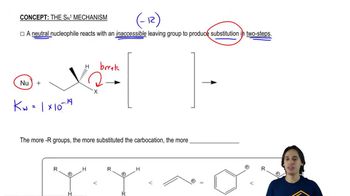
Step 1: Understand the SN1 mechanism. The SN1 reaction proceeds via a two-step process: (1) formation of a carbocation intermediate after the leaving group departs, and (2) nucleophilic attack on the carbocation. The rate of the reaction depends on the stability of the carbocation formed and the nature of the leaving group.
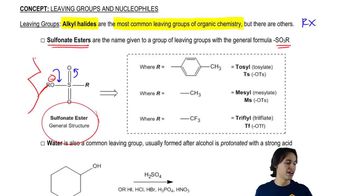
Step 2: Compare the leaving groups in each pair. The leaving group ability is determined by how easily it can depart and stabilize itself. Iodide (I⁻) is a better leaving group than bromide (Br⁻) or chloride (Cl⁻) because it is larger and more polarizable.
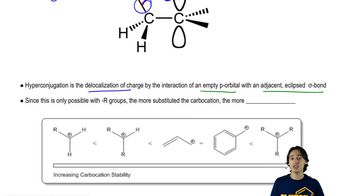
Step 3: Evaluate the carbocation stability for each compound. Carbocation stability increases in the order: primary < secondary < tertiary. Tertiary carbocations are the most stable due to hyperconjugation and inductive effects from surrounding alkyl groups.
Step 4: Analyze pair (e): 2-iodo-2-methylbutane vs. tert-butyl chloride. Both compounds form tertiary carbocations upon losing their leaving groups, but iodide is a better leaving group than chloride, making 2-iodo-2-methylbutane react faster via the SN1 mechanism.
Step 5: Analyze pair (f): 2-bromo-2-methylbutane vs. ethyl iodide. 2-bromo-2-methylbutane forms a tertiary carbocation, while ethyl iodide forms a primary carbocation. Since tertiary carbocations are more stable, 2-bromo-2-methylbutane will react faster via the SN1 mechanism despite bromide being a slightly weaker leaving group than iodide.

Risposta video verificata per un problema simile:
Questa soluzione video è stata consigliata dai nostri tutor come utile per risolvere questo problema.
Durata del video:
2mConcetti chiave
Ecco i concetti essenziali che devi comprendere per rispondere correttamente alla domanda.
SN1 Mechanism
The SN1 mechanism is a type of nucleophilic substitution reaction that involves two main steps: the formation of a carbocation intermediate and the subsequent attack by a nucleophile. The rate of the reaction depends primarily on the stability of the carbocation formed, which is influenced by factors such as the degree of substitution and the presence of electron-donating groups.
Video consigliato:
Drawing the SN1 Mechanism
Carbocation Stability
Carbocation stability is a crucial factor in determining the rate of SN1 reactions. Tertiary carbocations are more stable than secondary or primary ones due to hyperconjugation and inductive effects from surrounding alkyl groups. Therefore, substrates that can form more stable carbocations will react faster via the SN1 mechanism.
Video consigliato:
Determining Carbocation Stability
Leaving Groups
The quality of the leaving group significantly affects the rate of SN1 reactions. Good leaving groups, such as iodide and bromide, can stabilize the transition state and facilitate the formation of the carbocation. In general, the better the leaving group, the faster the reaction will proceed, as it can depart more easily during the first step of the SN1 mechanism.
Video consigliato:
The 3 important leaving groups to know.
Pratica correlata
Domanda del libro di testo
1856
views
Domanda del libro di testo
Propose an SN1 mechanism for the solvolysis of 3-bromo-2,3-dimethylpentane in ethanol.
2856
views
Domanda del libro di testo
Choose the member of each pair that will react faster by the SN1 mechanism.
c. n-propyl bromide or allyl bromide
d. 1-bromo-2,2-dimethylpropane or 2-bromopropane
1142
views
Domanda del libro di testo
Give the SN1 mechanism for the formation of 2-ethoxy-3-methylbutane, the unrearranged product in this reaction.
1657
views
Domanda del libro di testo
3-Bromocyclohexene is a secondary halide. It undergoes SN1 substitution about as fast as most tertiary halides. Use resonance structures to explain this enhanced reactivity.
2000
views
Domanda del libro di testo
Choose the member of each pair that will react faster by the SN1 mechanism.
a. 1-bromopropane or 2-bromopropane
b. 2-bromo-2-methylbutane or 2-bromo-3-methylbutane
1680
views