
Ch.6 - Alkyl Halides; Nucleophilic Substitution
Wade - Organic Chemistry 9th Edition
Wade9th EditionOrganic ChemistryISBN: 9780135213728Non è quello che usi tu?Cambia libro di testo
Capitolo 6, Problema 24a

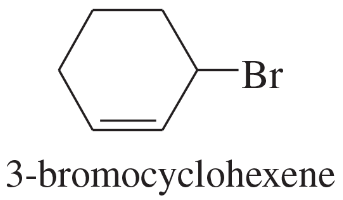
3-Bromocyclohexene is a secondary halide. It undergoes SN1 substitution about as fast as most tertiary halides. Use resonance structures to explain this enhanced reactivity.

Guida verificata passo dopo passo
1
Identify the structure of 3-bromocyclohexene, which consists of a cyclohexene ring with a bromine atom attached to the third carbon.
Recognize that the presence of the double bond in the cyclohexene ring allows for resonance stabilization of the carbocation formed during the SN1 reaction.
Draw the resonance structures: When the bromine leaves, a carbocation is formed at the third carbon. The positive charge can be delocalized to the adjacent carbon atoms through resonance with the double bond.
Illustrate the movement of electrons: The pi electrons from the double bond can move to form a new double bond with the carbocation, shifting the positive charge to the other carbon atom in the ring.
Explain that this resonance stabilization of the carbocation intermediate makes the SN1 reaction more favorable, enhancing the reactivity of 3-bromocyclohexene compared to other secondary halides without such stabilization.

Risposta video verificata per un problema simile:

Questa soluzione video è stata consigliata dai nostri tutor come utile per risolvere questo problema.
Durata del video:
5m

Concetti chiave

Ecco i concetti essenziali che devi comprendere per rispondere correttamente alla domanda.

SN1 Reaction Mechanism

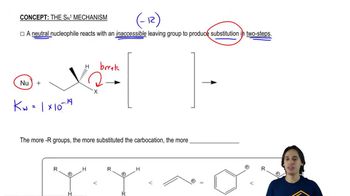
The SN1 reaction mechanism involves a two-step process where the leaving group departs first, forming a carbocation intermediate, followed by nucleophilic attack. The rate of SN1 reactions depends on the stability of the carbocation; more stable carbocations lead to faster reactions. This mechanism is common in tertiary halides due to their ability to stabilize positive charges.
Video consigliato:
10:49
Drawing the SN1 Mechanism

Carbocation Stability

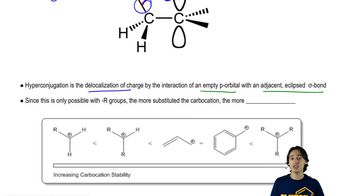
Carbocation stability is crucial in determining the rate of SN1 reactions. Stability is enhanced by factors such as hyperconjugation and resonance. Tertiary carbocations are generally more stable than secondary or primary ones due to greater hyperconjugation and inductive effects. In 3-bromocyclohexene, resonance stabilization plays a key role in enhancing carbocation stability.
Video consigliato:
05:58
Determining Carbocation Stability

Resonance Structures

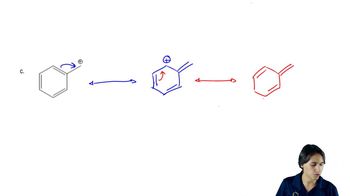
Resonance structures are different Lewis structures for a molecule that depict the delocalization of electrons. In 3-bromocyclohexene, the positive charge on the carbocation can be delocalized over the double bond, creating resonance structures that stabilize the intermediate. This delocalization increases the carbocation's stability, making the SN1 reaction proceed more rapidly, similar to tertiary halides.
Video consigliato:
03:04
Drawing Resonance Structures