Ch.6 - Alkyl Halides; Nucleophilic Substitution
Wade - Organic Chemistry 9th Edition
Wade9th EditionOrganic ChemistryISBN: 9780135213728Non è quello che usi tu?Cambia libro di testo
Capitolo 6, Problema 36

Give two syntheses for (CH3)2CH—O—CH2CH3, and explain which synthesis is better.

Guida verificata passo dopo passo
1
Step 1: Analyze the target molecule (CH3)2CH—O—CH2CH3. It is an ether, which can be synthesized using the Williamson ether synthesis. This method involves reacting an alkoxide ion with a primary alkyl halide.
Step 2: First synthesis approach: Use isopropanol ((CH3)2CH—OH) to form the isopropoxide ion by deprotonating it with a strong base like NaH or K. Then react the isopropoxide ion with ethyl bromide (CH3CH2Br) to form the desired ether.
Step 3: Second synthesis approach: Use ethanol (CH3CH2—OH) to form the ethoxide ion by deprotonating it with a strong base like NaH or K. Then react the ethoxide ion with isopropyl bromide ((CH3)2CH—Br) to form the desired ether.
Step 4: Compare the two syntheses: The Williamson ether synthesis works best when the alkyl halide is primary because secondary and tertiary alkyl halides are prone to elimination reactions under basic conditions. Therefore, the first synthesis (using ethyl bromide as the alkyl halide) is better because ethyl bromide is a primary alkyl halide, minimizing side reactions.
Step 5: Conclude: The first synthesis is preferred due to the reduced likelihood of elimination reactions and higher yield of the desired ether. The second synthesis may lead to side reactions due to the secondary nature of isopropyl bromide.

Risposta video verificata per un problema simile:

Questa soluzione video è stata consigliata dai nostri tutor come utile per risolvere questo problema.
Durata del video:
7m

Concetti chiave

Ecco i concetti essenziali che devi comprendere per rispondere correttamente alla domanda.

Nucleophilic Substitution Reactions

Nucleophilic substitution reactions involve the replacement of a leaving group in a molecule by a nucleophile. In the context of the question, the synthesis of (CH3)2CH—O—CH2CH3 can occur through either an SN1 or SN2 mechanism, depending on the structure of the reactants and the conditions. Understanding the nature of the nucleophile and the substrate is crucial for predicting the reaction pathway.
Video consigliato:
01:47
Nucleophiles and Electrophiles can react in Substitution Reactions.

SN2 Mechanism

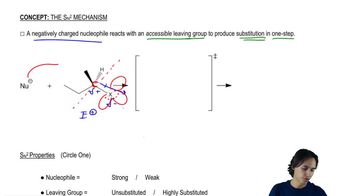
The SN2 mechanism is a one-step nucleophilic substitution process where the nucleophile attacks the electrophile simultaneously as the leaving group departs. This mechanism is characterized by a backside attack, leading to inversion of configuration at the carbon center. It is favored in primary and some secondary substrates, making it a potential pathway for synthesizing (CH3)2CH—O—CH2CH3.
Video consigliato:
08:33
Drawing the SN2 Mechanism

Reaction Conditions and Selectivity

The choice of reaction conditions, such as solvent, temperature, and concentration, significantly influences the outcome of nucleophilic substitution reactions. For example, polar aprotic solvents favor SN2 reactions by stabilizing the nucleophile without solvating it too much. Evaluating the conditions for each proposed synthesis will help determine which method is more efficient and yields a higher purity of the desired product.
Video consigliato:
10:08
Radical selectivity: Food Analogy
Pratica correlata
Domanda del libro di testo

Predict the compound in each pair that will undergo solvolysis (in aqueous ethanol) more rapidly.

(c)


(d)

855
views

Domanda del libro di testo

When ethyl bromide is added to potassium tert-butoxide, the product is ethyl tert-butyl ether.

CH3CH2–Br + (CH3)3C–O–K+ → (CH3)3C–O–CH2CH3 ethyl bromide potassium tert-butoxide ethyl tert-butyl ether

a. What happens to the reaction rate if the concentration of ethyl bromide is doubled?

1163
views
Domanda del libro di testo

Predict the compound in each pair that will undergo solvolysis (in aqueous ethanol) more rapidly.

(a) (CH3CH2)2CH—Cl or (CH3)3C—Cl

(b)

2256
views
Domanda del libro di testo

When tert-butyl bromide is heated with an equal amount of ethanol in an inert solvent, one of the products is ethyl tert-butyl ether.

a. What happens to the reaction rate if the concentration of ethanol is doubled?

1128
views
Domanda del libro di testo

Show how each compound might be synthesized by the SN2 displacement of an alkyl halide.

e. H2C=CH—CH2CN

f. H—C≡C—CH2CH2CH3

2346
views
Domanda del libro di testo

When ethyl bromide is added to potassium tert-butoxide, the product is ethyl tert-butyl ether.

CH3CH2–Br + (CH3)3C–O–K+ → (CH3)3C–O–CH2CH3 ethyl bromide potassium tert-butoxide ethyl tert-butyl ether

b. What happens to the rate if the concentration of potassium tert-butoxide is tripled and the concentration of ethyl ­bromide is doubled?

c. What happens to the rate if the temperature is raised?

1798
views