
Ch.6 - Alkyl Halides; Nucleophilic Substitution
Wade - Organic Chemistry 9th Edition
Wade9th EditionOrganic ChemistryISBN: 9780135213728Non è quello che usi tu?Cambia libro di testo
Capitolo 6, Problema 26c

Propose a mechanism involving a hydride shift or an alkyl shift for each solvolysis reaction. Explain how each rearrangement forms a more stable intermediate.
Hint: Most rearrangements convert 2° (or incipient 1°) carbocations to 3° or resonance-stabilized carbocations.
(c) Chemical reaction diagram showing the SN1 mechanism with reactants and products, including hydride or alkyl shifts.

Guida verificata passo dopo passo
1
Step 1: Begin by identifying the leaving group in the substrate. In this case, the iodine atom (I) attached to the cyclohexene ring is the leaving group. Under solvolysis conditions, the bond between the carbon and iodine breaks, forming a carbocation intermediate.
Step 2: Analyze the stability of the initially formed carbocation. The carbocation formed directly after the iodine leaves is a secondary carbocation. Secondary carbocations are less stable than tertiary carbocations or resonance-stabilized carbocations.
Step 3: Propose a rearrangement mechanism to stabilize the carbocation. A hydride shift or an alkyl shift can occur to convert the secondary carbocation into a more stable tertiary carbocation. In this case, a hydride shift from an adjacent carbon atom can occur, moving a hydrogen atom along with its bonding electrons to the carbocation center.
Step 4: After the hydride shift, the carbocation is now tertiary, which is more stable due to increased hyperconjugation and inductive effects. This rearranged carbocation is the key intermediate for the subsequent reaction.
Step 5: The rearranged carbocation reacts with acetic acid (CH3COOH) to form the final product. The nucleophilic oxygen atom in acetic acid attacks the carbocation, leading to the formation of the ester products shown in the reaction.

Risposta video verificata per un problema simile:

Questa soluzione video è stata consigliata dai nostri tutor come utile per risolvere questo problema.
Durata del video:
3m

Concetti chiave

Ecco i concetti essenziali che devi comprendere per rispondere correttamente alla domanda.

Carbocation Stability

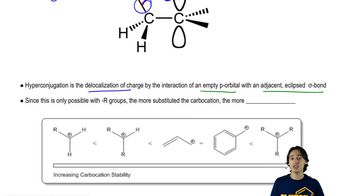
Carbocations are positively charged carbon species that can undergo rearrangements to achieve greater stability. The stability of carbocations increases in the order of primary < secondary < tertiary due to hyperconjugation and inductive effects from adjacent alkyl groups. In solvolysis reactions, rearrangements often convert less stable carbocations into more stable ones, such as transforming a secondary carbocation into a tertiary one.
Video consigliato:
05:58
Determining Carbocation Stability

Hydride and Alkyl Shifts

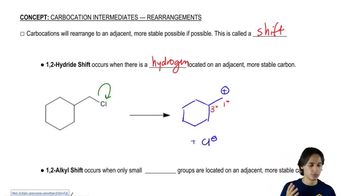
Hydride shifts involve the migration of a hydrogen atom with its bonding electrons from one carbon to an adjacent positively charged carbon, while alkyl shifts involve the movement of an alkyl group. These shifts are key mechanisms in carbocation rearrangements, allowing the molecule to form a more stable carbocation intermediate. Such shifts are often driven by the need to minimize the energy of the transition state and stabilize the resulting carbocation.
Video consigliato:
03:34
Hydride Shift

SN1 Mechanism

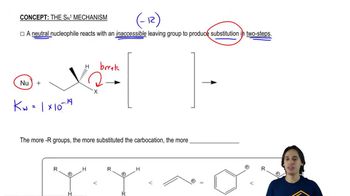
The SN1 mechanism is a type of nucleophilic substitution reaction characterized by a two-step process: the formation of a carbocation intermediate followed by nucleophilic attack. The first step is the rate-determining step, where the leaving group departs, forming a carbocation. The stability of this intermediate is crucial, as more stable carbocations lead to faster reaction rates and a higher likelihood of rearrangements, such as hydride or alkyl shifts, to achieve stability.
Video consigliato:
10:49
Drawing the SN1 Mechanism
Pratica correlata
Domanda del libro di testo

In the presence of a small amount of bromine, cyclohexene undergoes the following light-promoted reaction:

d. Explain why cyclohexene reacts with bromine much faster than cyclohexane, which must be heated to react.

1263
views
Domanda del libro di testo

For each reaction, give the expected substitution product, and predict whether the ­mechanism will be predominantly first order (SN1) or second order (SN2).

a. 2-chloro-2-methylbutane + CH3COOH

b. isobutylbromide + sodium methoxide

819
views
Domanda del libro di testo

Propose a mechanism involving a hydride shift or an alkyl shift for each solvolysis reaction. Explain how each rearrangement forms a more stable intermediate.

Hint: Most rearrangements convert 2° (or incipient 1°) carbocations to 3° or resonance-stabilized carbocations.

(b)

1791
views
Domanda del libro di testo

Give the SN1 mechanism for the formation of 2-ethoxy-3-methylbutane, the unrearranged product in this reaction.

1657
views
Domanda del libro di testo

Propose a mechanism involving a hydride shift or an alkyl shift for each solvolysis reaction. Explain how each rearrangement forms a more stable intermediate.

Hint: Most rearrangements convert 2° (or incipient 1°) carbocations to 3° or resonance-stabilized carbocations.

(d)

724
views
Domanda del libro di testo

For each reaction, give the expected substitution product, and predict whether the ­mechanism will be predominantly first order (SN1) or second order (SN2).

c. 1-iodo-1-methylcyclohexane + ethanol

763
views