
Ch. 02 - Describing Motion: Kinematics in One Dimension
Giancoli Douglas - Physics for Scientists and Engineers 5th edition
Giancoli Douglas5th editionPhysics for Scientists and EngineersISBN: 9780137488179Non è quello che usi tu?Cambia libro di testo
Capitolo 2, Problema 68c

A baseball is seen to pass upward by a window with a vertical speed of 13 m/s. If the ball was thrown by a person 18 m below on the street, when was it thrown?

Guida verificata passo dopo passo
1
Identify the known values: The vertical speed of the baseball as it passes the window is \( v = 13 \; \text{m/s} \), and the height difference between the thrower and the window is \( h = 18 \; \text{m} \). The acceleration due to gravity is \( g = 9.8 \; \text{m/s}^2 \). We need to determine the time \( t \) when the ball was thrown relative to the moment it passes the window.
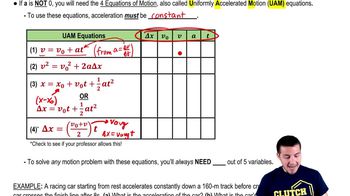
Use the kinematic equation for vertical motion: \( v = v_0 - g t \), where \( v_0 \) is the initial velocity of the ball, \( v \) is the velocity at a given time, \( g \) is the acceleration due to gravity, and \( t \) is the time elapsed. Rearrange this equation to express \( t \) in terms of \( v \) and \( v_0 \): \( t = \frac{v_0 - v}{g} \).
Next, use the kinematic equation for displacement: \( h = v_0 t - \frac{1}{2} g t^2 \), where \( h \) is the vertical displacement. Substitute the expression for \( t \) from the previous step into this equation to solve for \( v_0 \), the initial velocity of the ball.
Once \( v_0 \) is determined, substitute it back into the equation \( t = \frac{v_0 - v}{g} \) to calculate the time \( t \) when the ball was thrown relative to the moment it passes the window.
Perform the algebraic manipulations and substitutions carefully to ensure consistency in units and accuracy in solving for \( t \). This will give you the time elapsed from the throw to the moment the ball passes the window.

Risposta video verificata per un problema simile:

Questa soluzione video è stata consigliata dai nostri tutor come utile per risolvere questo problema.

Concetti chiave

Ecco i concetti essenziali che devi comprendere per rispondere correttamente alla domanda.

Kinematics

Kinematics is the branch of physics that deals with the motion of objects without considering the forces that cause the motion. It involves concepts such as displacement, velocity, and acceleration. In this scenario, understanding the kinematic equations is essential to determine the time it takes for the baseball to travel upward from the point of release to the window.
Video consigliato:
Percorso guidato
08:25
Kinematics Equations

Projectile Motion

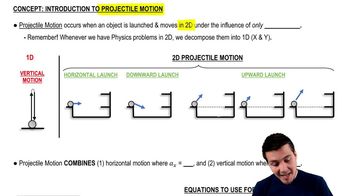
Projectile motion refers to the motion of an object that is thrown into the air and is subject to gravitational acceleration. The path of a projectile is typically parabolic, and its vertical and horizontal motions can be analyzed separately. In this case, the baseball's upward motion and the effect of gravity on its trajectory are crucial for calculating when it was thrown.
Video consigliato:
Percorso guidato
04:44
Introduction to Projectile Motion

Acceleration due to Gravity

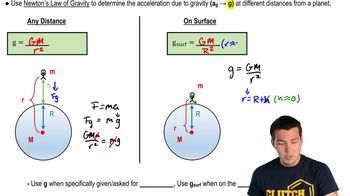
Acceleration due to gravity is the rate at which an object accelerates towards the Earth when in free fall, approximately 9.81 m/s². This constant affects the vertical motion of the baseball after it is thrown. Understanding how gravity influences the ball's upward speed and its eventual descent is vital for determining the time of the throw.
Video consigliato:
Percorso guidato
05:20
Acceleration Due to Gravity
Pratica correlata
Domanda del libro di testo

A rocket rises vertically, from rest, with an acceleration of 3.2 m/s² until it runs out of fuel at an altitude of 725 m. After this point, its acceleration is that of gravity, downward. What maximum altitude does the rocket reach?

1889
views
Domanda del libro di testo

The position of a ball rolling in a straight line is given by 𝓍 = 2.0 ― 3.6t + 1.7t², where 𝓍 is in meters and t in seconds. What do the numbers 2.0, 3.6, and 1.7 refer to?

1578
views
Domanda del libro di testo

Air resistance acting on a falling body can be taken into account by the approximate relation for the acceleration: a = dv/dt = g ― kv, where k is a constant. Determine an expression for the terminal velocity, which is the maximum value the velocity reaches.

1465
views
Domanda del libro di testo

Roger sees water balloons fall past his window. He notices that each balloon strikes the sidewalk 0.83 s after passing his window, 15 m above the sidewalk. Assuming the balloons are being released from rest, from what height are they being released?

1353
views
Domanda del libro di testo

A helicopter is ascending vertically with a constant speed of 6.40 m/s. At a height of 105 m above the Earth, a package is dropped from the helicopter. How much time does it take for the package to reach the ground? [Hint: What is v₀ for the package?]

1876
views
Domanda del libro di testo

A falling stone takes 0.28 s to travel past a window 2.2 m tall (Fig. 2–49). From what height above the top of the window did the stone fall?

1790
views