
Ch. 02 - Describing Motion: Kinematics in One Dimension
Giancoli Douglas - Physics for Scientists and Engineers 5th edition
Giancoli Douglas5th editionPhysics for Scientists and EngineersISBN: 9780137488179Non è quello che usi tu?Cambia libro di testo
Capitolo 2, Problema 67b

Roger sees water balloons fall past his window. He notices that each balloon strikes the sidewalk 0.83 s after passing his window, 15 m above the sidewalk. Assuming the balloons are being released from rest, from what height are they being released?

Guida verificata passo dopo passo
1
Identify the known values: The time it takes for the balloon to hit the sidewalk after passing the window is \( t = 0.83 \; \text{s} \), the height of the window above the sidewalk is \( h_{\text{window}} = 15 \; \text{m} \), and the initial velocity of the balloon as it passes the window is \( v_{\text{window}} = 0 \; \text{m/s} \) (since it is released from rest). The acceleration due to gravity is \( g = 9.8 \; \text{m/s}^2 \).
Use the kinematic equation to calculate the velocity of the balloon as it passes the window: \( v_{\text{window}}^2 = v_0^2 + 2g h_{\text{window}} \). Since \( v_0 = 0 \), this simplifies to \( v_{\text{window}} = \sqrt{2 g h_{\text{window}}} \).
Determine the total time of free fall from the release point to the sidewalk. The total time is the sum of the time it takes to fall from the release point to the window and the time it takes to fall from the window to the sidewalk. Let \( t_{\text{total}} \) represent the total time and \( t_{\text{window}} = 0.83 \; \text{s} \).
Use the kinematic equation \( h = v_0 t + \frac{1}{2} g t^2 \) to calculate the height from which the balloon is released. Here, \( h \) is the total height, \( v_0 = 0 \), and \( t = t_{\text{total}} \). Rearrange the equation to solve for \( h \): \( h = \frac{1}{2} g t_{\text{total}}^2 \).
Add the height of the window above the sidewalk to the calculated height from the release point to the window to find the total height from which the balloon is released: \( h_{\text{release}} = h + h_{\text{window}} \).

Risposta video verificata per un problema simile:

Questa soluzione video è stata consigliata dai nostri tutor come utile per risolvere questo problema.

Concetti chiave

Ecco i concetti essenziali che devi comprendere per rispondere correttamente alla domanda.

Kinematics

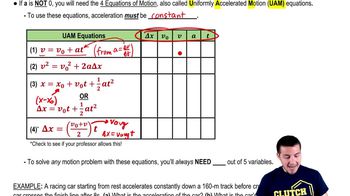
Kinematics is the branch of mechanics that describes the motion of objects without considering the forces that cause the motion. It involves concepts such as displacement, velocity, acceleration, and time. In this problem, kinematic equations will be used to relate the height from which the balloons are released to the time they take to fall.
Video consigliato:
Percorso guidato
08:25
Kinematics Equations

Free Fall

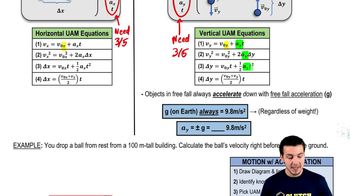
Free fall refers to the motion of an object under the influence of gravity alone, with no other forces acting on it. In this scenario, the water balloons are falling freely, meaning they accelerate downward at a rate of approximately 9.81 m/s², the acceleration due to gravity. Understanding free fall is essential for calculating the height from which the balloons were released.
Video consigliato:
Percorso guidato
08:36
Vertical Motion & Free Fall

Kinematic Equations

Kinematic equations are mathematical formulas that relate an object's displacement, initial velocity, final velocity, acceleration, and time. For objects in free fall, one commonly used equation is h = vt + (1/2)at², where h is the height, v is the initial velocity, a is the acceleration, and t is the time. These equations will help determine the initial height of the balloons based on the given time and distance.
Video consigliato:
Percorso guidato
08:25
Kinematics Equations
Pratica correlata