
Ch. 02 - Describing Motion: Kinematics in One Dimension
Giancoli Douglas - Physics for Scientists and Engineers 5th edition
Giancoli Douglas5th editionPhysics for Scientists and EngineersISBN: 9780137488179Non è quello che usi tu?Cambia libro di testo
Capitolo 2, Problema 66

A helicopter is ascending vertically with a constant speed of 6.40 m/s. At a height of 105 m above the Earth, a package is dropped from the helicopter. How much time does it take for the package to reach the ground? [Hint: What is v₀ for the package?]

Guida verificata passo dopo passo
1
Identify the known values: The initial velocity of the package, \(v_0\), is the same as the helicopter's vertical speed, which is \(6.40\, \text{m/s}\) upward. The initial height of the package above the ground is \(h_0 = 105\, \text{m}\). The acceleration due to gravity, \(g\), is \(9.80\, \text{m/s}^2\) downward. The final position of the package when it reaches the ground is \(h = 0\).
Write the kinematic equation for vertical motion: \(h = h_0 + v_0 t - \frac{1}{2} g t^2\). Substitute \(h = 0\), \(h_0 = 105\, \text{m}\), \(v_0 = 6.40\, \text{m/s}\), and \(g = 9.80\, \text{m/s}^2\) into the equation.
Rearrange the equation to form a standard quadratic equation: \(0 = 105 + 6.40t - \frac{1}{2}(9.80)t^2\). Simplify further to \(0 = -4.90t^2 + 6.40t + 105\).
Solve the quadratic equation \(-4.90t^2 + 6.40t + 105 = 0\) using the quadratic formula: \(t = \frac{-b \pm \sqrt{b^2 - 4ac}}{2a}\), where \(a = -4.90\), \(b = 6.40\), and \(c = 105\).
Calculate the discriminant \(\Delta = b^2 - 4ac\) and determine the two possible solutions for \(t\). Discard the negative solution since time cannot be negative. The positive solution will give the time it takes for the package to reach the ground.

Risposta video verificata per un problema simile:

Questa soluzione video è stata consigliata dai nostri tutor come utile per risolvere questo problema.

Concetti chiave

Ecco i concetti essenziali che devi comprendere per rispondere correttamente alla domanda.

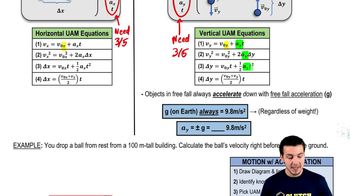
Free Fall

Free fall refers to the motion of an object under the influence of gravity alone, without any air resistance. When the package is dropped from the helicopter, it begins to accelerate downward due to Earth's gravitational pull, which is approximately 9.81 m/s². Understanding free fall is crucial for calculating the time it takes for the package to reach the ground.
Video consigliato:
Percorso guidato
08:36
Vertical Motion & Free Fall

Initial Velocity

The initial velocity (v₀) of an object is the speed at which it starts its motion. In this scenario, the package is dropped from a helicopter ascending at 6.40 m/s, meaning its initial velocity when released is also 6.40 m/s upward. This initial velocity affects the time it takes for the package to reach the ground, as it will initially move upward before gravity pulls it down.
Video consigliato:
Percorso guidato
7:27
Escape Velocity

Kinematic Equations

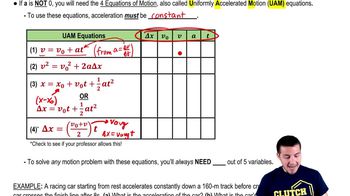
Kinematic equations describe the motion of objects under constant acceleration. They relate displacement, initial velocity, final velocity, acceleration, and time. In this problem, we can use the kinematic equation that incorporates initial velocity, acceleration due to gravity, and displacement to determine the time it takes for the package to hit the ground.
Video consigliato:
Percorso guidato
08:25
Kinematics Equations