
Ch. 02 - Describing Motion: Kinematics in One Dimension
Giancoli Douglas - Physics for Scientists and Engineers 5th edition
Giancoli Douglas5th editionPhysics for Scientists and EngineersISBN: 9780137488179Non è quello che usi tu?Cambia libro di testo
Capitolo 2, Problema 60

For an object falling freely from rest, show that the distance traveled during each successive second increases in the ratio of successive odd integers (1, 3, 5, etc.). (This was first shown by Galileo.) See Figs. 2–27 and 2–30.

Guida verificata passo dopo passo
1
Start by recalling the kinematic equation for the distance traveled by an object under constant acceleration: s = v_0t + (1/2)at^2. Since the object is falling freely from rest, the initial velocity v_0 is 0, and the equation simplifies to s = (1/2)gt^2, where g is the acceleration due to gravity.
To find the distance traveled during each successive second, calculate the distance traveled at the end of time t and subtract the distance traveled at the end of time t-1. This gives the distance traveled in the t-th second: s_t = (1/2)g t^2 - (1/2)g (t-1)^2.
Simplify the expression for s_t: Expand the squares to get s_t = (1/2)g (t^2 - (t^2 - 2t + 1)). Simplify further to obtain s_t = (1/2)g (2t - 1), which represents the distance traveled during the t-th second.
Observe that the distance traveled during successive seconds is proportional to the sequence 2t - 1, which generates the odd integers: 1, 3, 5, etc., as t increases.
Conclude that the distance traveled during each successive second increases in the ratio of successive odd integers (1, 3, 5, etc.), as shown by Galileo. This result arises from the quadratic dependence of distance on time in uniformly accelerated motion.

Risposta video verificata per un problema simile:

Questa soluzione video è stata consigliata dai nostri tutor come utile per risolvere questo problema.

Concetti chiave

Ecco i concetti essenziali che devi comprendere per rispondere correttamente alla domanda.

Free Fall

Free fall refers to the motion of an object under the influence of gravity alone, with no other forces acting on it, such as air resistance. In this scenario, the object accelerates downward at a constant rate, approximately 9.81 m/s² on Earth. Understanding free fall is crucial for analyzing the motion of objects in gravitational fields.
Video consigliato:
Percorso guidato
08:36
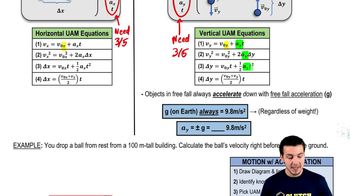
Vertical Motion & Free Fall

Distance Traveled in Free Fall

The distance traveled by an object in free fall can be calculated using the equation d = 1/2 g t², where d is the distance, g is the acceleration due to gravity, and t is the time in seconds. This equation shows that the distance increases with the square of the time, leading to greater distances covered in successive seconds.
Video consigliato:
Percorso guidato
08:36
Vertical Motion & Free Fall

Odd Integer Ratios

The concept of odd integer ratios arises from the distances covered in each second of free fall. Specifically, the distance traveled in the first second is 1 unit, in the second second is 3 units, and in the third second is 5 units, forming the sequence of odd integers. This pattern illustrates how the distance increases non-linearly, emphasizing the accelerating nature of free fall.
Video consigliato:
Percorso guidato
05:32
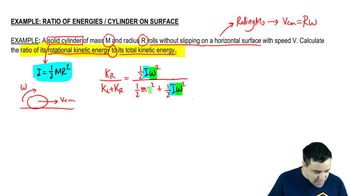
Ratio of energies of cylinder on surface
Pratica correlata
Domanda del libro di testo

A baseball pitcher throws a baseball with a speed of 43 m/s. Estimate the average acceleration of the ball during the throwing motion. In throwing the baseball, the pitcher accelerates it through a displacement of about 3.5 m, from behind the body to the point where it is released (Fig. 2–44).

<IMAGE>

1556
views
Domanda del libro di testo

A rocket rises vertically, from rest, with an acceleration of 3.2 m/s² until it runs out of fuel at an altitude of 725 m. After this point, its acceleration is that of gravity, downward. What maximum altitude does the rocket reach?

1889
views
Domanda del libro di testo

A car traveling 85 km/h slows down at a constant 0.50 m/s² just by 'letting up on the gas.' Calculate the distance it travels during the first and fifth seconds.

1745
views
Domanda del libro di testo

Roger sees water balloons fall past his window. He notices that each balloon strikes the sidewalk 0.83 s after passing his window, 15 m above the sidewalk. Assuming the balloons are being released from rest, from what height are they being released?

1353
views
Domanda del libro di testo

A helicopter is ascending vertically with a constant speed of 6.40 m/s. At a height of 105 m above the Earth, a package is dropped from the helicopter. How much time does it take for the package to reach the ground? [Hint: What is v₀ for the package?]

1876
views
Domanda del libro di testo

Figure 2–42 shows the velocity of a train as a function of time. During what periods, if any, was the acceleration constant?

1895
views