An airplane is traveling 815 km/h in a direction 41.5° west of north (Fig. 3–40). Find the components of the velocity vector in the northerly and westerly directions.
Ch. 03 - Kinematics in Two or Three Dimensions; Vectors
Giancoli Douglas5th editionPhysics for Scientists and EngineersISBN: 9780137488179Non è quello che usi tu?Cambia libro di testo
Tutti i libri di testo
Giancoli Douglas 5th edition
Ch. 03 - Kinematics in Two or Three Dimensions; Vectors
Problema 10
Giancoli Douglas 5th edition
Ch. 03 - Kinematics in Two or Three Dimensions; Vectors
Problema 10Capitolo 3, Problema 10
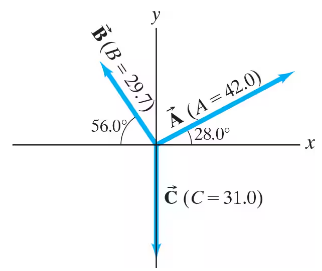
Three vectors are shown in Fig. 3–41. Their magnitudes are given in arbitrary units. Determine the sum of the three vectors. Give the resultant in terms of (a) components, (b) magnitude and angle with the +𝓍 axis.

Guida verificata passo dopo passo1
Identify the components of each vector. For each vector, break it into its x and y components using trigonometry. Use the formulas: x-component = magnitude × cos(θ) and y-component = magnitude × sin(θ), where θ is the angle the vector makes with the +x axis.
Sum the x-components of all three vectors to find the resultant x-component (Rₓ). Similarly, sum the y-components of all three vectors to find the resultant y-component (Rᵧ). Use the equations: Rₓ = Σx-components and Rᵧ = Σy-components.
To find the magnitude of the resultant vector, use the Pythagorean theorem: magnitude = √(Rₓ² + Rᵧ²).
Determine the angle of the resultant vector with respect to the +x axis using the formula: θ = tan⁻¹(Rᵧ / Rₓ). Ensure you consider the signs of Rₓ and Rᵧ to place the angle in the correct quadrant.
Combine the results to express the resultant vector in terms of its magnitude and angle, as well as its components (Rₓ and Rᵧ).
Concetti chiave
Ecco i concetti essenziali che devi comprendere per rispondere correttamente alla domanda.
Vector Addition
Vector addition involves combining two or more vectors to determine a resultant vector. This can be done graphically by placing the tail of one vector at the head of another or mathematically by adding their components. The resultant vector represents the cumulative effect of the individual vectors in both magnitude and direction.
Video consigliato:
Percorso guidato
Vector Addition By Components
Components of a Vector
Vectors can be broken down into their components along the coordinate axes, typically the x and y axes in two-dimensional space. The x-component represents the horizontal influence, while the y-component represents the vertical influence. This decomposition simplifies calculations, allowing for easier addition and analysis of vectors.
Video consigliato:
Percorso guidato
Vector Addition By Components
Magnitude and Direction
The magnitude of a vector is its length, representing the size or strength of the vector, while the direction indicates the vector's orientation in space. The angle with respect to a reference axis, such as the +x axis, is often used to describe the direction. Understanding both magnitude and direction is essential for fully characterizing a vector's effect in a physical context.
Video consigliato:
Percorso guidato
Calculating Magnitude & Components of a Vector
Pratica correlata
Domanda del libro di testo
2055
views
Domanda del libro di testo
Figure 3–39 shows two vectors, and , whose magnitudes are A = 6.8 units and B = 5.5 units. Determine if = + . Give the magnitude and direction for each.
2018
views
Domanda del libro di testo
A car is moving with speed 16.0 m/s due south at one moment and 25.7 m/s due east 8.00 s later. Over this time interval, determine the magnitude and direction of (a) its average velocity, (b) its average acceleration. (c) What is its average speed? [Hint: Can you determine all these from the information given?]
2176
views
Domanda del libro di testo
Two vectors, and , add to a resultant . Describe and if .
2057
views
Domanda del libro di testo
A delivery truck travels 21 blocks north, 16 blocks east, and 26 blocks south. What is its final displacement from the origin? Assume the blocks are equal length.
2228
views