An airplane is traveling 815 km/h in a direction 41.5° west of north (Fig. 3–40). Find the components of the velocity vector in the northerly and westerly directions.
Ch. 03 - Kinematics in Two or Three Dimensions; Vectors
Giancoli Douglas5th editionPhysics for Scientists and EngineersISBN: 9780137488179Non è quello che usi tu?Cambia libro di testo
Tutti i libri di testo
Giancoli Douglas 5th edition
Ch. 03 - Kinematics in Two or Three Dimensions; Vectors
Problema 13b
Giancoli Douglas 5th edition
Ch. 03 - Kinematics in Two or Three Dimensions; Vectors
Problema 13bCapitolo 3, Problema 13b
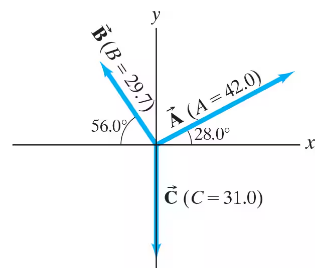
For the vectors shown in Fig. 3–41, determine 2 A - 3 B + 2 C.

Guida verificata passo dopo passo1
Step 1: Understand the problem. You are tasked with finding the resultant vector from the expression 2A - 3B + 2C, where A, B, and C are vectors. Refer to Fig. 3–41 for the components or directions of these vectors.
Step 2: Break each vector (A, B, and C) into its components. For example, if vector A has components Ax and Ay, write A as A = (Ax, Ay). Do the same for vectors B and C.
Step 3: Multiply each vector by its respective scalar. For instance, multiply vector A by 2 to get 2A = (2Ax, 2Ay). Similarly, calculate -3B = (-3Bx, -3By) and 2C = (2Cx, 2Cy).
Step 4: Add the components of the scaled vectors together. For the x-components, compute: (2Ax) + (-3Bx) + (2Cx). For the y-components, compute: (2Ay) + (-3By) + (2Cy).
Step 5: Combine the results from Step 4 to express the resultant vector in component form as R = (Rx, Ry), where Rx is the sum of the x-components and Ry is the sum of the y-components. If needed, you can also find the magnitude and direction of the resultant vector using the formulas: |R| = sqrt(Rx^2 + Ry^2) and θ = arctan(Ry/Rx).
Concetti chiave
Ecco i concetti essenziali che devi comprendere per rispondere correttamente alla domanda.
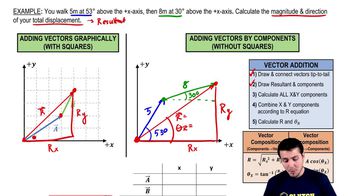
Vector Addition
Vector addition is the process of combining two or more vectors to produce a resultant vector. This involves adding the corresponding components of the vectors, which can be visualized graphically by placing the tail of one vector at the head of another. The resultant vector represents the cumulative effect of the individual vectors in both magnitude and direction.
Video consigliato:
Percorso guidato
Vector Addition By Components
Scalar Multiplication
Scalar multiplication involves multiplying a vector by a scalar (a real number), which scales the vector's magnitude without changing its direction. For example, multiplying a vector by 2 doubles its length, while multiplying by -1 reverses its direction. This concept is essential when manipulating vectors in expressions like 2A or -3B.
Video consigliato:
Percorso guidato
Introduction to Vectors and Scalars
Linear Combination of Vectors
A linear combination of vectors involves creating a new vector by multiplying each vector by a scalar and then adding the results. In the expression 2A - 3B + 2C, each vector A, B, and C is scaled by its respective coefficient, and the resulting vectors are summed. This concept is fundamental in vector spaces and is used to express complex vector relationships.
Video consigliato:
Percorso guidato
Linear Thermal Expansion
Pratica correlata
Domanda del libro di testo
2055
views
Domanda del libro di testo
Figure 3–39 shows two vectors, and , whose magnitudes are A = 6.8 units and B = 5.5 units. Determine if = + . Give the magnitude and direction for each.
2018
views
Domanda del libro di testo
A car is moving with speed 16.0 m/s due south at one moment and 25.7 m/s due east 8.00 s later. Over this time interval, determine the magnitude and direction of (a) its average velocity, (b) its average acceleration. (c) What is its average speed? [Hint: Can you determine all these from the information given?]
2176
views
Domanda del libro di testo
A skier is accelerating down a 30.0° hill at 1.80 m/s² (Fig. 3–42). What is the vertical component of her acceleration?
<IMAGE>
2085
views
Domanda del libro di testo
Two vectors, and , add to a resultant . Describe and if .
2057
views