
Ch. 15 - Wave Motion
Giancoli Douglas - Physics for Scientists and Engineers 5th edition
Giancoli Douglas5th editionPhysics for Scientists and EngineersISBN: 9780137488179Non è quello che usi tu?Cambia libro di testo
Capitolo 15, Problema 60a

A standing wave on a 1.85-m-long horizontal string displays three loops when the string vibrates at 125 Hz. The maximum swing of the string (top to bottom) at the center of each loop is 8.00 cm. What is the function describing the standing wave?

Guida verificata passo dopo passo
1
Step 1: Understand the problem. A standing wave is formed on a string with three loops, meaning the string vibrates in its third harmonic. The string length is 1.85 m, the frequency is 125 Hz, and the amplitude (maximum displacement) is 8.00 cm. We need to derive the wave function describing this standing wave.
Step 2: Determine the wavelength of the standing wave. For the third harmonic, the string length corresponds to 1.5 wavelengths. Use the relationship \( L = \frac{n \lambda}{2} \), where \( L \) is the string length, \( n \) is the harmonic number (3 in this case), and \( \lambda \) is the wavelength. Solve for \( \lambda \).
Step 3: Calculate the wave speed. Use the formula \( v = f \lambda \), where \( v \) is the wave speed, \( f \) is the frequency (125 Hz), and \( \lambda \) is the wavelength determined in Step 2.
Step 4: Write the general form of the standing wave function. The standing wave can be described as \( y(x, t) = 2A \sin(kx) \cos(\omega t) \), where \( A \) is the amplitude (4.00 cm, since the maximum swing is top to bottom), \( k \) is the wave number \( k = \frac{2\pi}{\lambda} \), and \( \omega \) is the angular frequency \( \omega = 2\pi f \). Substitute the known values for \( A \), \( k \), and \( \omega \).
Step 5: Finalize the wave function. Combine the values from previous steps into the equation \( y(x, t) = 2A \sin(kx) \cos(\omega t) \), ensuring all units are consistent (meters for length, seconds for time). This function describes the standing wave on the string.

Concetti chiave

Ecco i concetti essenziali che devi comprendere per rispondere correttamente alla domanda.

Standing Waves

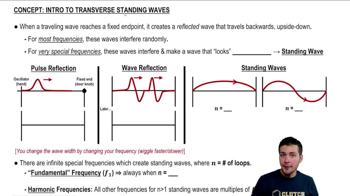
Standing waves are formed when two waves of the same frequency and amplitude travel in opposite directions and interfere with each other. This results in a wave pattern that appears to be stationary, characterized by nodes (points of no displacement) and antinodes (points of maximum displacement). In this case, the three loops indicate the presence of three antinodes along the string.
Video consigliato:
Percorso guidato
07:58
Intro to Transverse Standing Waves

Wave Function

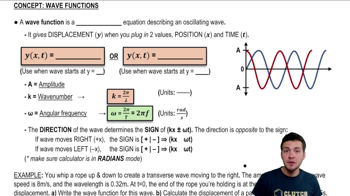
The wave function describes the displacement of points on a wave as a function of time and position. For standing waves, this can often be expressed in the form of a sine or cosine function, incorporating parameters such as amplitude, wavelength, and frequency. The general form for a standing wave can be written as y(x, t) = A sin(kx) cos(ωt), where A is the amplitude, k is the wave number, and ω is the angular frequency.
Video consigliato:
Percorso guidato
08:30
Intro to Wave Functions

Frequency and Wavelength

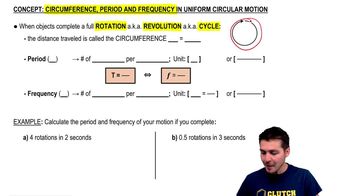
Frequency is the number of oscillations or cycles that occur in a unit of time, measured in Hertz (Hz). Wavelength is the distance between successive points of the same phase on a wave, such as crest to crest. The relationship between frequency (f), wavelength (λ), and wave speed (v) is given by the equation v = fλ, which is essential for determining the characteristics of the standing wave in the string.
Video consigliato:
Percorso guidato
05:08
Circumference, Period, and Frequency in UCM
Pratica correlata
Domanda del libro di testo

The displacement of a standing wave on a string is given by D = 2.4sin(0.60x)cos(42t), where x and D are in centimeters and t is in seconds. Give the amplitude, frequency, and speed of each of the component waves.

975
views
Domanda del libro di testo

When you slosh the water back and forth in a tub at just the right frequency, the water alternately rises and falls at each end, remaining relatively calm at the center. Suppose the frequency to produce such a standing wave in a 45-cm-wide tub is 0.85 Hz. What is the speed of the water wave?

1054
views
Domanda del libro di testo

(II) For any type of wave that reaches a boundary beyond which its speed is increased, there is a maximum incident angle if there is to be a transmitted refracted wave. This maximum incident angle θiM corresponds to an angle of refraction equal to 90°. If θᵢ > θiM, all the wave is reflected at the boundary and none is refracted, because this would correspond to sin θᵣ > 1 (where is the angle θᵣ of refraction), which is impossible.

(a) Find a formula for θiM using the law of refraction, Eq. 15–19.

1257
views
Domanda del libro di testo

A particular violin string plays at a frequency of 294 Hz. If the tension is increased 22%, what will the new frequency be?

1141
views
Domanda del libro di testo

A longitudinal earthquake wave strikes a boundary between two types of rock at a 41° angle. As the wave crosses the boundary, the specific gravity of the rock changes from 3.6 to 2.8. Assuming that the elastic modulus (Section 15–2)is the same for both types of rock, determine the angle of refraction.

1263
views
Domanda del libro di testo

The displacement of a standing wave on a string is given by D = 2.4 sin ( 0.60x ) cos (42t) , where x and D are in centimeters and t is in seconds. What is the distance (cm) between nodes?

1313
views