
Ch. 15 - Wave Motion
Giancoli Douglas - Physics for Scientists and Engineers 5th edition
Giancoli Douglas5th editionPhysics for Scientists and EngineersISBN: 9780137488179Non è quello che usi tu?Cambia libro di testo
Capitolo 15, Problema 44d

Suppose two linear waves of equal amplitude and frequency have a phase difference ϕ as they travel in the same medium. They can be represented by: D₁ = A sin (kx - ωt); D₂ = A sin ( kx - ωt + ϕ). Describe the resultant wave, by equation and in words, if ϕ = π/2.

Guida verificata passo dopo passo
1
Step 1: Write down the equations for the two waves. The first wave is represented as D₁ = A sin(kx - ωt), and the second wave is represented as D₂ = A sin(kx - ωt + ϕ). Here, A is the amplitude, k is the wave number, ω is the angular frequency, t is time, x is position, and ϕ is the phase difference.
Step 2: Add the two wave equations to find the resultant wave. The resultant wave is given by D = D₁ + D₂. Substituting the expressions for D₁ and D₂, we get D = A sin(kx - ωt) + A sin(kx - ωt + ϕ).
Step 3: Use the trigonometric identity for the sum of two sine functions: sin(α) + sin(β) = 2 sin((α + β)/2) cos((α - β)/2). Here, α = kx - ωt and β = kx - ωt + ϕ. Applying this identity, the resultant wave becomes D = 2A cos(ϕ/2) sin(kx - ωt + ϕ/2).
Step 4: Substitute the given phase difference ϕ = π/2 into the resultant wave equation. When ϕ = π/2, cos(ϕ/2) = cos(π/4) = √2/2, and the resultant wave becomes D = 2A(√2/2) sin(kx - ωt + π/4). Simplify this to D = √2A sin(kx - ωt + π/4).
Step 5: Interpret the resultant wave. The resultant wave has an amplitude of √2A, which is larger than the amplitude of the individual waves (A). The phase of the resultant wave is shifted by π/4 compared to the original waves. This means the two waves interfere constructively but with a phase shift, resulting in a new wave with increased amplitude and a phase offset.

Risposta video verificata per un problema simile:

Questa soluzione video è stata consigliata dai nostri tutor come utile per risolvere questo problema.
Durata del video:
5m

Concetti chiave

Ecco i concetti essenziali che devi comprendere per rispondere correttamente alla domanda.

Wave Superposition

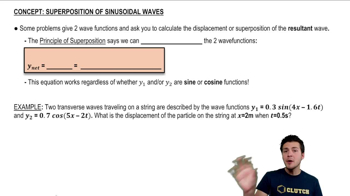
Wave superposition is the principle that when two or more waves overlap in a medium, the resultant displacement at any point is the sum of the displacements due to each individual wave. This principle is fundamental in understanding how waves interact, leading to phenomena such as constructive and destructive interference, which can significantly alter the characteristics of the resultant wave.
Video consigliato:
Percorso guidato
03:32
Superposition of Sinusoidal Wave Functions

Phase Difference

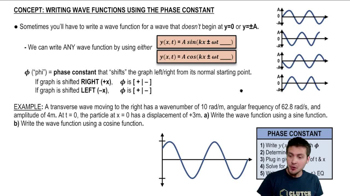
Phase difference refers to the difference in the phase of two waves at a given point in time and space. It is typically measured in radians and can affect how waves combine. For instance, a phase difference of π/2 (90 degrees) indicates that one wave reaches its peak a quarter cycle before the other, leading to unique interference patterns in the resultant wave.
Video consigliato:
Percorso guidato
08:59
Phase Constant of a Wave Function

Resultant Wave Equation

The resultant wave equation describes the combined effect of two or more waves. In the case of two waves with a phase difference, the resultant wave can be expressed mathematically using trigonometric identities. For example, when ϕ = π/2, the resultant wave can be represented as a sine function that incorporates both the amplitude and the phase difference, illustrating how the waves interact to form a new wave pattern.
Video consigliato:
Percorso guidato
06:28
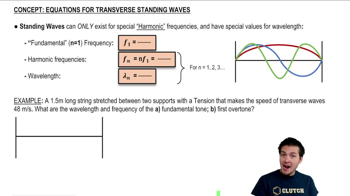
Equations for Transverse Standing Waves