Ch. 15 - Wave Motion
Giancoli Douglas - Physics for Scientists and Engineers 5th edition
Giancoli Douglas5th editionPhysics for Scientists and EngineersISBN: 9780137488179Non è quello che usi tu?Cambia libro di testo
Capitolo 15, Problema 30

Write the equation for the wave in Problem 29 traveling to the right, if its amplitude is 0.020 cm, and D = - 0.020 cm, at t = 0 and x = 0.

Guida verificata passo dopo passo
1
Understand the general form of a traveling wave equation: \( y(x, t) = A \sin(kx - \omega t + \phi) \), where \( A \) is the amplitude, \( k \) is the wave number, \( \omega \) is the angular frequency, and \( \phi \) is the phase constant.
Identify the given values: The amplitude \( A \) is 0.020 cm, and at \( t = 0 \) and \( x = 0 \), \( D = -0.020 \) cm. This information will help determine the phase constant \( \phi \).
Substitute \( x = 0 \), \( t = 0 \), and \( y = -0.020 \) cm into the wave equation: \( -0.020 = 0.020 \sin(\phi) \). Solve for \( \phi \) to find the phase constant.
Once \( \phi \) is determined, the wave equation can be written as \( y(x, t) = 0.020 \sin(kx - \omega t + \phi) \). The values of \( k \) (wave number) and \( \omega \) (angular frequency) would need to be determined from additional information about the wave, such as its wavelength or frequency.
Combine all the known values (amplitude, phase constant, and any additional parameters like \( k \) or \( \omega \)) into the wave equation to express the final form of the wave traveling to the right.

Risposta video verificata per un problema simile:

Questa soluzione video è stata consigliata dai nostri tutor come utile per risolvere questo problema.
Durata del video:
9m

Concetti chiave

Ecco i concetti essenziali che devi comprendere per rispondere correttamente alla domanda.

Wave Equation

The wave equation describes the relationship between the displacement of a wave and its position and time. For a sinusoidal wave traveling to the right, the general form is y(x, t) = A sin(kx - ωt + φ), where A is the amplitude, k is the wave number, ω is the angular frequency, and φ is the phase constant. Understanding this equation is crucial for determining the characteristics of the wave in the problem.
Video consigliato:
Percorso guidato
06:28
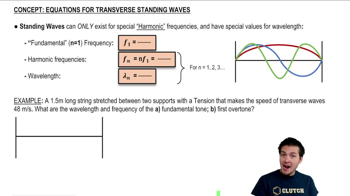
Equations for Transverse Standing Waves

Amplitude

Amplitude refers to the maximum displacement of points on a wave from its rest position. In this context, an amplitude of 0.020 cm indicates how far the wave oscillates above and below its equilibrium position. It is a key factor in determining the wave's energy and intensity, as higher amplitudes correspond to greater energy.
Video consigliato:
Percorso guidato
04:24
Amplitude Decay in an LRC Circuit

Phase Shift

Phase shift is the horizontal shift of a wave in relation to a reference point, often expressed in radians or degrees. In the given problem, D = -0.020 cm at t = 0 and x = 0 suggests a specific initial condition that affects the phase of the wave. Understanding phase shifts is essential for accurately writing the wave equation and predicting its behavior over time.
Video consigliato:
Percorso guidato
08:59
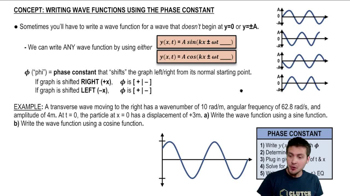
Phase Constant of a Wave Function