Ch. 15 - Wave Motion
Giancoli Douglas - Physics for Scientists and Engineers 5th edition
Giancoli Douglas5th editionPhysics for Scientists and EngineersISBN: 9780137488179Non è quello che usi tu?Cambia libro di testo
Capitolo 15, Problema 32b

A transverse wave on a cord is given by D(x,t) = 0.12 sin (3.0x - 15.0t), where D and x are in meters and t is in seconds. At t = 0.20s, what are the displacement, velocity, and acceleration of a point on the cord where x = 0.60 m?

Guida verificata passo dopo passo
1
Step 1: Write down the given wave equation: \( D(x, t) = 0.12 \sin(3.0x - 15.0t) \), where \( D \) is the displacement in meters, \( x \) is the position in meters, and \( t \) is the time in seconds. Identify the values given in the problem: \( t = 0.20 \, \text{s} \) and \( x = 0.60 \, \text{m} \).
Step 2: To find the displacement \( D \) at \( t = 0.20 \, \text{s} \) and \( x = 0.60 \, \text{m} \), substitute these values into the wave equation: \( D(0.60, 0.20) = 0.12 \sin(3.0(0.60) - 15.0(0.20)) \). Simplify the argument of the sine function to calculate \( D \).
Step 3: To find the velocity of the point on the cord, take the partial derivative of \( D(x, t) \) with respect to time \( t \): \( v(x, t) = \frac{\partial D(x, t)}{\partial t} = -0.12 \cdot 15.0 \cos(3.0x - 15.0t) \). Substitute \( x = 0.60 \, \text{m} \) and \( t = 0.20 \, \text{s} \) into this expression to calculate the velocity.
Step 4: To find the acceleration of the point on the cord, take the second partial derivative of \( D(x, t) \) with respect to time \( t \): \( a(x, t) = \frac{\partial^2 D(x, t)}{\partial t^2} = -0.12 \cdot 15.0^2 \sin(3.0x - 15.0t) \). Substitute \( x = 0.60 \, \text{m} \) and \( t = 0.20 \, \text{s} \) into this expression to calculate the acceleration.
Step 5: After substituting the values into the equations for displacement, velocity, and acceleration, simplify each expression to find the numerical results. Ensure the units are consistent throughout the calculations: displacement in meters, velocity in meters per second, and acceleration in meters per second squared.

Risposta video verificata per un problema simile:

Questa soluzione video è stata consigliata dai nostri tutor come utile per risolvere questo problema.
Durata del video:
7m

Concetti chiave

Ecco i concetti essenziali che devi comprendere per rispondere correttamente alla domanda.

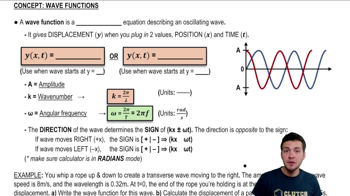
Wave Function

The wave function describes the displacement of a wave at any point in space and time. In this case, D(x, t) = 0.12 sin(3.0x - 15.0t) represents a sinusoidal wave, where the amplitude is 0.12 m, the wave number is 3.0 rad/m, and the angular frequency is 15.0 rad/s. Understanding the wave function is crucial for determining the wave's behavior at specific points.
Video consigliato:
Percorso guidato
08:30
Intro to Wave Functions

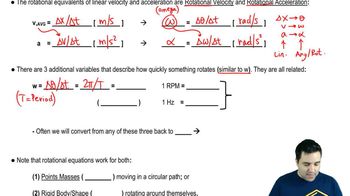
Displacement, Velocity, and Acceleration

Displacement refers to the position of a point on the wave at a given time, while velocity is the rate of change of displacement with respect to time, and acceleration is the rate of change of velocity. For a wave, these quantities can be derived from the wave function by taking the first and second derivatives with respect to time, allowing us to analyze the motion of points on the cord.
Video consigliato:
Percorso guidato
11:21
Rotational Velocity & Acceleration

Partial Derivatives

Partial derivatives are used to find how a function changes with respect to one variable while keeping others constant. In the context of wave motion, we use partial derivatives of the wave function D(x, t) to calculate the velocity and acceleration of a point on the cord at a specific position and time, which is essential for solving the problem presented.
Video consigliato:
Percorso guidato
04:59
Partial Dielectrics