

Ch. 18 - Kinetic Theory of Gases
Giancoli Douglas - Physics for Scientists and Engineers 5th edition
Giancoli Douglas5th editionPhysics for Scientists and EngineersISBN: 9780137488179Non è quello che usi tu?Cambia libro di testo
Capitolo 18, Problema 69

A space vehicle returning from the Moon enters the Earth’s atmosphere at a speed of about 42,000 km/h. Molecules (assume nitrogen) striking the nose of the vehicle with this speed correspond to what temperature? (Because of this high temperature, the nose of a space vehicle must be made of special materials; indeed, part of it does vaporize, and this is seen as a bright blaze upon reentry.)

Guida verificata passo dopo passo
1
Convert the speed of the space vehicle from km/h to m/s. Use the conversion factor: 1 km/h = 1000/3600 m/s. This will give the speed in SI units, which is necessary for further calculations.
Relate the kinetic energy of the nitrogen molecules to the temperature using the equation for the average kinetic energy of a molecule: Ek = (3/2)kT, where k is the Boltzmann constant and T is the temperature.
Equate the kinetic energy of the nitrogen molecules to the macroscopic kinetic energy of the vehicle. The macroscopic kinetic energy is given by Ek = (1/2)m², where m is the mass of a nitrogen molecule and v is the speed of the vehicle.
Solve for the temperature T by substituting the expression for kinetic energy into the equation Ek = (3/2)kT. Rearrange to isolate T: T = (m²)/(3k).
Substitute the known values into the equation: the mass of a nitrogen molecule (approximately 4.65 × 10⁻²⁶ kg), the Boltzmann constant (1.38 × 10⁻²³ J/K), and the speed of the vehicle in m/s. Perform the calculation to find the temperature.

Risposta video verificata per un problema simile:

Questa soluzione video è stata consigliata dai nostri tutor come utile per risolvere questo problema.
Durata del video:
4m

Concetti chiave

Ecco i concetti essenziali che devi comprendere per rispondere correttamente alla domanda.

Kinetic Energy and Temperature

Kinetic energy is the energy possessed by an object due to its motion, which is directly related to its speed. The temperature of a gas is a measure of the average kinetic energy of its molecules. As the speed of the molecules increases, so does their kinetic energy, leading to a higher temperature. This relationship is crucial for understanding how the high speed of the space vehicle translates into thermal energy upon atmospheric entry.
Video consigliato:
Percorso guidato
06:07
Intro to Rotational Kinetic Energy

Heat Transfer and Friction

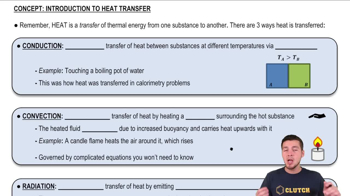
When a space vehicle reenters the Earth's atmosphere, it encounters air resistance, which generates friction. This friction converts the kinetic energy of the vehicle into thermal energy, causing the surface temperature to rise significantly. Understanding the principles of heat transfer, particularly conduction and convection, is essential to grasp how the vehicle's materials must withstand extreme temperatures during reentry.
Video consigliato:
Percorso guidato
05:14
Overview of Heat Transfer

Material Science and Thermal Protection

Material science focuses on the properties and applications of materials, particularly under extreme conditions. In the context of space vehicles, thermal protection systems are designed to shield the vehicle from the intense heat generated during reentry. Special materials, such as ablative heat shields, are engineered to absorb and dissipate heat, preventing structural damage and ensuring the safety of the vehicle and its occupants.
Video consigliato:
Percorso guidato
05:21
Volume Thermal Expansion
Pratica correlata
Domanda del libro di testo

At room temperature, it takes approximately 2.45 x 10³ J to evaporate 1.00 g of water. Estimate the average speed of evaporating molecules. What multiple of vrms (at 20°C) for water molecules is this? (Assume Eq. 18–4 holds.)

961
views
Domanda del libro di testo

The escape speed from the Earth is 1.12 x 10⁴ m/s (Section 8–7). So a gas molecule traveling away from Earth near the outer boundary of the Earth’s atmosphere would, at this speed, be able to escape from the Earth’s gravitational field and be lost to the atmosphere. Can you explain why our atmosphere contains oxygen but not helium?

955
views
Domanda del libro di testo

A sauna has 7.8 m³ of air volume, and the temperature is 85°C. The air is perfectly dry. How much water (in kg) should be evaporated if we want to increase the relative humidity from 0% to 10%? (See Table 18–2.)

1522
views
Domanda del libro di testo

A sample of cesium vapor is in an oven at 400°C. The volume of the oven is 75 cm³, the vapor pressure of Cs at 400°C is 17 mm-Hg, and the diameter of cesium atoms in the vapor is 0.33 nm. Determine the number of collisions a single Cs atom undergoes with other cesium atoms per second.

1007
views
Domanda del libro di testo

Calculate the total water vapor pressure in the air on the following day: a hot summer day, with the temperature 30°C and the relative humidity at 75%.

1212
views
Domanda del libro di testo

A scuba tank has a volume of 3100 cm³. For very deep dives, the tank is filled with 50% (by volume) pure oxygen and 50% pure helium. What is the ratio of the average kinetic energies of the two types of molecule?

1262
views