Domanda del libro di testo
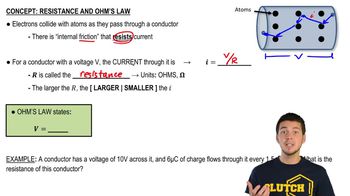
(a) What is the current in the 13-Ω heating element of a 240-V clothes dryer?
(b) How much charge passes through the element in 15 min? (Assume direct current.)
1260
views

 Giancoli Douglas 5th editionCh. 25 - Electric Current and ResistanceProblema 8b
 Guida verificata passo dopo passo
 03:07
03:07
 07:51
07:51 06:18
06:18(a) What is the current in the 13-Ω heating element of a 240-V clothes dryer?
(b) How much charge passes through the element in 15 min? (Assume direct current.)
A 4.5-V battery is connected to a bulb whose resistance is 2.3 Ω. How many electrons leave the battery per minute?
A rectangular solid made of carbon has sides of lengths 1.0 cm, 2.0 cm, and 4.0 cm, lying along the x, y, and z axes, respectively (Fig. 25–36). Determine the resistance for current that passes through the solid in the y direction, (Assume the resistivity is ρ = 3.0 x 10⁻⁵ Ω•m).
What voltage will produce 0.25 A of current through a 5400-Ω resistor?
Neglect the internal resistance of a battery unless the problem refers to it. Ten 7.0-W Christmas tree lights are connected in series to each other and to a 120-V source. What is the resistance of each bulb?
Calculate the terminal voltage for a battery with an internal resistance of 0.900 Ω and an emf of 6.00 V when the battery is connected in series with a 61.0-Ω resistor.