Ch. 25 - Electric Current and Resistance
Giancoli Douglas - Physics for Scientists and Engineers 5th edition
Giancoli Douglas5th editionPhysics for Scientists and EngineersISBN: 9780137488179Non è quello che usi tu?Cambia libro di testo
Capitolo 24, Problema 7

(a) What is the current in the 13-Ω heating element of a 240-V clothes dryer?
(b) How much charge passes through the element in 15 min? (Assume direct current.)

Guida verificata passo dopo passo
1
Step 1: Use Ohm's Law to calculate the current in the heating element. Ohm's Law is given by \( I = \frac{V}{R} \), where \( I \) is the current, \( V \) is the voltage, and \( R \) is the resistance. Substitute \( V = 240 \, \text{V} \) and \( R = 13 \, \Omega \) into the formula.
Step 2: Once the current \( I \) is determined, calculate the total charge \( Q \) that passes through the element using the relationship \( Q = I \cdot t \), where \( t \) is the time in seconds. Convert the given time of 15 minutes into seconds by multiplying by 60 (\( t = 15 \cdot 60 \)).
Step 3: Substitute the value of \( I \) (calculated in Step 1) and \( t \) (calculated in Step 2) into the formula \( Q = I \cdot t \) to find the total charge.
Step 4: Ensure that the units are consistent throughout the calculations. Voltage is in volts (V), resistance is in ohms (\( \Omega \)), current is in amperes (A), time is in seconds (s), and charge is in coulombs (C).
Step 5: Review the calculations to ensure accuracy and verify that the results align with the physical principles of direct current circuits.

Risposta video verificata per un problema simile:

Questa soluzione video è stata consigliata dai nostri tutor come utile per risolvere questo problema.
Durata del video:
7m

Concetti chiave

Ecco i concetti essenziali che devi comprendere per rispondere correttamente alla domanda.

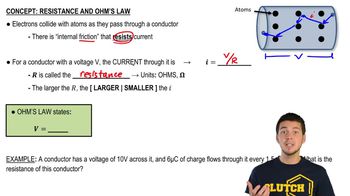
Ohm's Law

Ohm's Law states that the current (I) flowing through a conductor between two points is directly proportional to the voltage (V) across the two points and inversely proportional to the resistance (R) of the conductor. It is mathematically expressed as I = V/R. This principle is fundamental for calculating the current in electrical circuits, such as the heating element in the clothes dryer.
Video consigliato:
Percorso guidato
03:07
Resistance and Ohm's Law

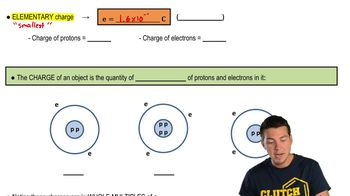
Electric Charge

Electric charge is a physical property of matter that causes it to experience a force when placed in an electromagnetic field. The unit of charge is the coulomb (C). In the context of the question, the total charge (Q) that passes through the heating element can be calculated using the formula Q = I × t, where I is the current and t is the time in seconds.
Video consigliato:
Percorso guidato
05:37
Electric Charge

Direct Current (DC)

Direct current (DC) is the unidirectional flow of electric charge, meaning that the electric charge flows in a constant direction. This is in contrast to alternating current (AC), where the flow of charge periodically reverses direction. In the context of the clothes dryer, assuming direct current simplifies the calculations for current and charge over time, as the values remain constant.
Video consigliato:
Percorso guidato
09:49
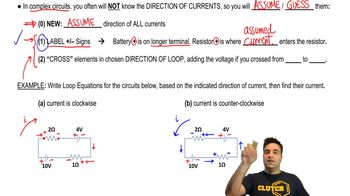
Direction of Current in Loop Equations