Ch. 25 - Electric Current and Resistance
Giancoli Douglas - Physics for Scientists and Engineers 5th edition
Giancoli Douglas5th editionPhysics for Scientists and EngineersISBN: 9780137488179Non è quello che usi tu?Cambia libro di testo
Capitolo 24, Problema 10

A 4.5-V battery is connected to a bulb whose resistance is 2.3 Ω. How many electrons leave the battery per minute?

Guida verificata passo dopo passo
1
Step 1: Use Ohm's Law to calculate the current (I) flowing through the circuit. Ohm's Law is given by I=VR, where V is the voltage (4.5 V) and R is the resistance (2.3 Ω).
Step 2: Once the current I is determined, calculate the total charge (Q) that flows through the circuit in one minute. Use the formula Q=It, where t is the time in seconds (1 minute = 60 seconds).
Step 3: Recall that the charge of a single electron is approximately e-=1.6×10⁻¹⁹C. To find the number of electrons, divide the total charge Q by the charge of a single electron using the formula n=Qe-.
Step 4: Substitute the values for Q (from Step 2) and e- into the formula to calculate the number of electrons n.
Step 5: Ensure the units are consistent throughout the calculation and verify the result to confirm it makes physical sense (e.g., the number of electrons should be a very large number).

Risposta video verificata per un problema simile:

Questa soluzione video è stata consigliata dai nostri tutor come utile per risolvere questo problema.
Durata del video:
2m

Concetti chiave

Ecco i concetti essenziali che devi comprendere per rispondere correttamente alla domanda.

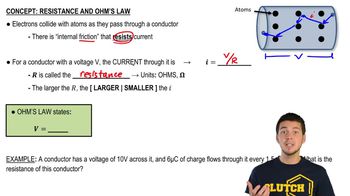
Ohm's Law

Ohm's Law states that the current (I) flowing through a conductor between two points is directly proportional to the voltage (V) across the two points and inversely proportional to the resistance (R) of the conductor. It is mathematically expressed as V = I × R. This relationship is crucial for determining the current in the circuit when a voltage is applied to a resistor.
Video consigliato:
Percorso guidato
03:07
Resistance and Ohm's Law

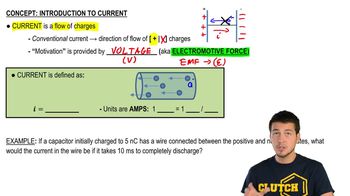
Current and Charge

Electric current is the flow of electric charge, typically measured in amperes (A). One ampere is defined as one coulomb of charge passing through a point in a circuit per second. Understanding the relationship between current and charge is essential for calculating how many electrons flow through the circuit over a given time period.
Video consigliato:
Percorso guidato
05:38
Intro to Current

Elementary Charge

The elementary charge is the smallest unit of electric charge, represented by the symbol 'e', and is approximately equal to 1.6 × 10^-19 coulombs. Since electrons carry a negative charge equal to this value, knowing the charge of an electron is necessary to convert the total charge flowing in the circuit into the number of electrons that pass through.
Video consigliato:
Pratica correlata
Domanda del libro di testo

(a) What is the current in the 13-Ω heating element of a 240-V clothes dryer?

(b) How much charge passes through the element in 15 min? (Assume direct current.)

1260
views

Domanda del libro di testo

The filament of an incandescent lightbulb has a resistance of 12 Ω at 20°C and 140 Ω when hot.

(a) Calculate the temperature of the filament when it is hot, and take into account the change in length and area of the filament due to thermal expansion (assume tungsten for which the thermal expansion coefficient is ≈ 5.5 10⁻⁶ C°⁻¹ ).

(b) In this temperature range, what is the percentage change in resistance due to thermal expansion, and what is the percentage change in resistance due solely to the change in ρ? Use Eq. 25–5.

1045
views
Domanda del libro di testo

A 12-V battery causes a current of 0.50 A through a resistor. How many joules of energy does the battery lose in a minute?

1134
views
Domanda del libro di testo

A rectangular solid made of carbon has sides of lengths 1.0 cm, 2.0 cm, and 4.0 cm, lying along the x, y, and z axes, respectively (Fig. 25–36). Determine the resistance for current that passes through the solid in the y direction, (Assume the resistivity is ρ = 3.0 x 10⁻⁵ Ω•m).

1367
views
Domanda del libro di testo

Neglect the internal resistance of a battery unless the problem refers to it. Ten 7.0-W Christmas tree lights are connected in series to each other and to a 120-V source. What is the resistance of each bulb?

1409
views
Domanda del libro di testo

Calculate the terminal voltage for a battery with an internal resistance of 0.900 Ω and an emf of 6.00 V when the battery is connected in series with a 61.0-Ω resistor.

1012
views