
Ch. 25 - Electric Current and Resistance
Giancoli Douglas - Physics for Scientists and Engineers 5th edition
Giancoli Douglas5th editionPhysics for Scientists and EngineersISBN: 9780137488179Non è quello che usi tu?Cambia libro di testo
Capitolo 24, Problema 39

A flashlight uses two AA 1.5-V batteries connected in series to provide 3.0 V across the bulb, as in Fig. 25–4b. The bulb draws 135 mA when turned on.
(a) Calculate the resistance of the bulb and the power dissipated.
(b) By what factor would the power increase if four AA batteries in series (total 6.0 V) were used with the same bulb? (Neglect heating effects of the filament.) Why shouldn’t you try this?

Guida verificata passo dopo passo
1
Step 1: Understand the problem. The flashlight uses two AA batteries in series, providing a total voltage of 3.0 V. The bulb draws a current of 135 mA (0.135 A). We need to calculate the resistance of the bulb and the power dissipated. Then, we analyze the effect of using four AA batteries (6.0 V) on the power and discuss why this might be problematic.
Step 2: Use Ohm's Law to calculate the resistance of the bulb. Ohm's Law is given by \( V = IR \), where \( V \) is the voltage, \( I \) is the current, and \( R \) is the resistance. Rearrange the formula to solve for \( R \): \( R = \frac{V}{I} \). Substitute \( V = 3.0 \ \text{V} \) and \( I = 0.135 \ \text{A} \) into the equation.
Step 3: Calculate the power dissipated by the bulb using the formula \( P = IV \), where \( P \) is the power, \( I \) is the current, and \( V \) is the voltage. Substitute \( I = 0.135 \ \text{A} \) and \( V = 3.0 \ \text{V} \) into the equation.
Step 4: Analyze the effect of using four AA batteries (6.0 V) on the power. The resistance of the bulb remains constant, so use the formula \( P = \frac{V^2}{R} \) to calculate the new power. Substitute \( V = 6.0 \ \text{V} \) and the previously calculated resistance \( R \) into the equation. Compare the new power to the original power to determine the factor by which the power increases.
Step 5: Discuss why using four AA batteries might be problematic. The increased power means the bulb will dissipate more energy as heat, which could cause the filament to overheat and fail. This is because the bulb is not designed to handle the higher voltage and power.

Risposta video verificata per un problema simile:

Questa soluzione video è stata consigliata dai nostri tutor come utile per risolvere questo problema.
Durata del video:
5m

Concetti chiave

Ecco i concetti essenziali che devi comprendere per rispondere correttamente alla domanda.

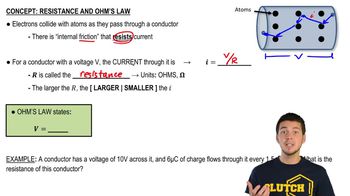
Ohm's Law

Ohm's Law states that the current (I) flowing through a conductor between two points is directly proportional to the voltage (V) across the two points and inversely proportional to the resistance (R) of the conductor. This relationship is expressed mathematically as V = I × R. Understanding this law is essential for calculating the resistance of the bulb in the flashlight, as it allows us to relate the voltage supplied by the batteries to the current drawn by the bulb.
Video consigliato:
Percorso guidato
03:07
Resistance and Ohm's Law

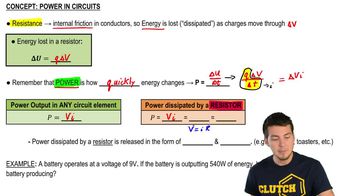
Power in Electrical Circuits

The power (P) dissipated in an electrical circuit can be calculated using the formula P = V × I, where V is the voltage across the component and I is the current flowing through it. This concept is crucial for determining how much power the bulb consumes when the flashlight is turned on. Additionally, understanding power dissipation helps in evaluating the efficiency and safety of electrical devices.
Video consigliato:
Percorso guidato
06:18
Power in Circuits

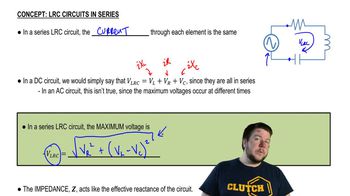
Series Circuits

In a series circuit, components are connected end-to-end, so the same current flows through each component, while the total voltage is the sum of the individual voltages across each component. When using four AA batteries in series, the total voltage increases to 6.0 V, which affects the current and power drawn by the bulb. However, increasing the voltage beyond the rated capacity of the bulb can lead to overheating and potential damage, which is why caution is advised.
Video consigliato:
Percorso guidato
05:55
LRC Circuits in Series