Ch. 25 - Electric Current and Resistance
Giancoli Douglas - Physics for Scientists and Engineers 5th edition
Giancoli Douglas5th editionPhysics for Scientists and EngineersISBN: 9780137488179Non è quello che usi tu?Cambia libro di testo
Capitolo 24, Problema 35

You buy a 75-W lightbulb in Europe, where electricity is delivered at 240 V. If you use the bulb in the United States at 120 V (assume its resistance does not change), how bright will it be relative to 75-W 120-V bulbs? [Hint: Assume roughly that brightness is proportional to power consumed.]

Guida verificata passo dopo passo
1
Determine the resistance of the 75-W lightbulb when it operates at 240 V. Use the formula for power: P = V2 / R, where P is power, V is voltage, and R is resistance. Rearrange to solve for resistance: R = V2 / P.
Substitute the given values for the European operation: V = 240 \(\text{ V}\) and P = 75 \(\text{ W}\). This will give the resistance of the bulb, which remains constant regardless of the voltage.
Now calculate the power consumed by the bulb when it operates in the United States at 120 V. Use the same power formula: P = V2 / R. Substitute V = 120 \(\text{ V}\) and the resistance R calculated in the previous step.
Compare the power consumed by the bulb at 120 V to the power of a standard 75-W 120-V bulb. The brightness is proportional to the power consumed, so the ratio of the two powers will give the relative brightness.
Express the relative brightness as a fraction or percentage by dividing the power consumed by the bulb at 120 V by 75 W (the power of the standard bulb) and multiplying by 100 if needed.

Risposta video verificata per un problema simile:

Questa soluzione video è stata consigliata dai nostri tutor come utile per risolvere questo problema.
Durata del video:
3m

Concetti chiave

Ecco i concetti essenziali che devi comprendere per rispondere correttamente alla domanda.

Power and Brightness

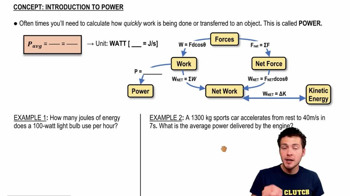
In electrical systems, power (measured in watts) is the rate at which energy is consumed or converted. For lightbulbs, brightness is often proportional to the power they consume; thus, a bulb rated at 75 W will generally be brighter than one rated at a lower wattage. Understanding this relationship is crucial for comparing the brightness of bulbs operating at different voltages.
Video consigliato:

Ohm's Law

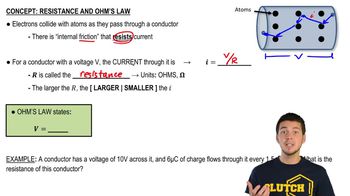
Ohm's Law states that the current (I) flowing through a conductor between two points is directly proportional to the voltage (V) across the two points and inversely proportional to the resistance (R) of the conductor, expressed as V = IR. This principle helps in determining how the current changes when the voltage is altered, which is essential for analyzing the performance of the lightbulb at different voltages.
Video consigliato:
Percorso guidato
03:07
Resistance and Ohm's Law

Resistance and Voltage Relationship

The resistance of a lightbulb remains constant when its temperature is stable. When using a bulb designed for 240 V in a 120 V system, the power consumed can be calculated using the formula P = V^2/R. This means that at a lower voltage, the power (and thus brightness) will decrease, which is key to understanding how the bulb will perform in the U.S. compared to its intended use in Europe.
Video consigliato:
Percorso guidato
07:14
RMS Current and Voltage
Pratica correlata
Domanda del libro di testo

An electric car uses a 45-kW (160-hp) motor. If the battery pack is designed for 340 V, what current would the motor need to draw from the battery? Neglect any energy losses in getting energy from the battery to the motor.

1206
views
Domanda del libro di testo

The filament of an incandescent lightbulb has a resistance of 12 Ω at 20°C and 140 Ω when hot.

(a) Calculate the temperature of the filament when it is hot, and take into account the change in length and area of the filament due to thermal expansion (assume tungsten for which the thermal expansion coefficient is ≈ 5.5 10⁻⁶ C°⁻¹ ).

(b) In this temperature range, what is the percentage change in resistance due to thermal expansion, and what is the percentage change in resistance due solely to the change in ρ? Use Eq. 25–5.

1045
views
Domanda del libro di testo

A flashlight uses two AA 1.5-V batteries connected in series to provide 3.0 V across the bulb, as in Fig. 25–4b. The bulb draws 135 mA when turned on.

(a) Calculate the resistance of the bulb and the power dissipated.

(b) By what factor would the power increase if four AA batteries in series (total 6.0 V) were used with the same bulb? (Neglect heating effects of the filament.) Why shouldn’t you try this?

994
views
Domanda del libro di testo

At \$0.12/kWh, what does it cost to leave a 25-W porch light on day and night for a year?

1020
views
Domanda del libro di testo

The heating element of an electric oven is designed to produce 3.1 kW of heat when connected to a 240-V source. What must be the resistance of the element?

1082
views
Domanda del libro di testo

(II) A power station delivers 750 kW of power at 12,000 V to a factory through wires with total resistance 3.0 Ω. How much less power is wasted if the electricity is delivered at 50,000 V rather than 12,000 V?

1308
views