
Ch. 25 - Electric Current and Resistance
Giancoli Douglas - Physics for Scientists and Engineers 5th edition
Giancoli Douglas5th editionPhysics for Scientists and EngineersISBN: 9780137488179Non è quello che usi tu?Cambia libro di testo
Capitolo 24, Problema 26

The filament of an incandescent lightbulb has a resistance of 12 Ω at 20°C and 140 Ω when hot.
(a) Calculate the temperature of the filament when it is hot, and take into account the change in length and area of the filament due to thermal expansion (assume tungsten for which the thermal expansion coefficient is ≈ 5.5 10⁻⁶ C°⁻¹ ).
(b) In this temperature range, what is the percentage change in resistance due to thermal expansion, and what is the percentage change in resistance due solely to the change in ρ? Use Eq. 25–5.

Guida verificata passo dopo passo
1
Step 1: Start by understanding the relationship between resistance and temperature. The resistance of a material changes with temperature according to the formula: R=R0(1+α(T-T0)), where R0 is the resistance at the reference temperature T0, α is the temperature coefficient of resistivity, and T is the temperature of interest.
Step 2: Rearrange the formula to solve for the temperature T when the resistance is known: T=T0+R-R0R0α. Use the given values: R0=12 Ω, R=140 Ω, and the temperature coefficient of resistivity for tungsten, α=4.5×10⁻³ C°⁻¹.
Step 3: Account for the effects of thermal expansion on the resistance. The resistance of a wire also depends on its length and cross-sectional area, which change with temperature. The resistance can be expressed as: R=ρLA, where ρ is the resistivity, L is the length, and A is the cross-sectional area. Use the thermal expansion coefficient β=5.5×10⁻⁶ C°⁻¹ to calculate the change in length and area.
Step 4: Calculate the percentage change in resistance due to thermal expansion. The change in length ΔL is proportional to the temperature change: ΔLL=β(T-T0). The cross-sectional area A changes as the square of the length, so the resistance change due to thermal expansion can be approximated.
Step 5: Calculate the percentage change in resistance due solely to the change in resistivity ρ. Use the formula for resistivity change: Δρρ=α(T-T0). Combine the results to determine the overall percentage change in resistance and separate the contributions from thermal expansion and resistivity change.

Risposta video verificata per un problema simile:

Questa soluzione video è stata consigliata dai nostri tutor come utile per risolvere questo problema.
Durata del video:
10m

Concetti chiave

Ecco i concetti essenziali che devi comprendere per rispondere correttamente alla domanda.

Resistance and Temperature Relationship

The resistance of a conductor, such as tungsten, changes with temperature. This relationship is often described by the formula R(T) = R0(1 + α(T - T0)), where R0 is the resistance at a reference temperature T0, α is the temperature coefficient of resistance, and T is the new temperature. Understanding this concept is crucial for calculating the filament's temperature when it is hot.
Video consigliato:
Percorso guidato
04:54
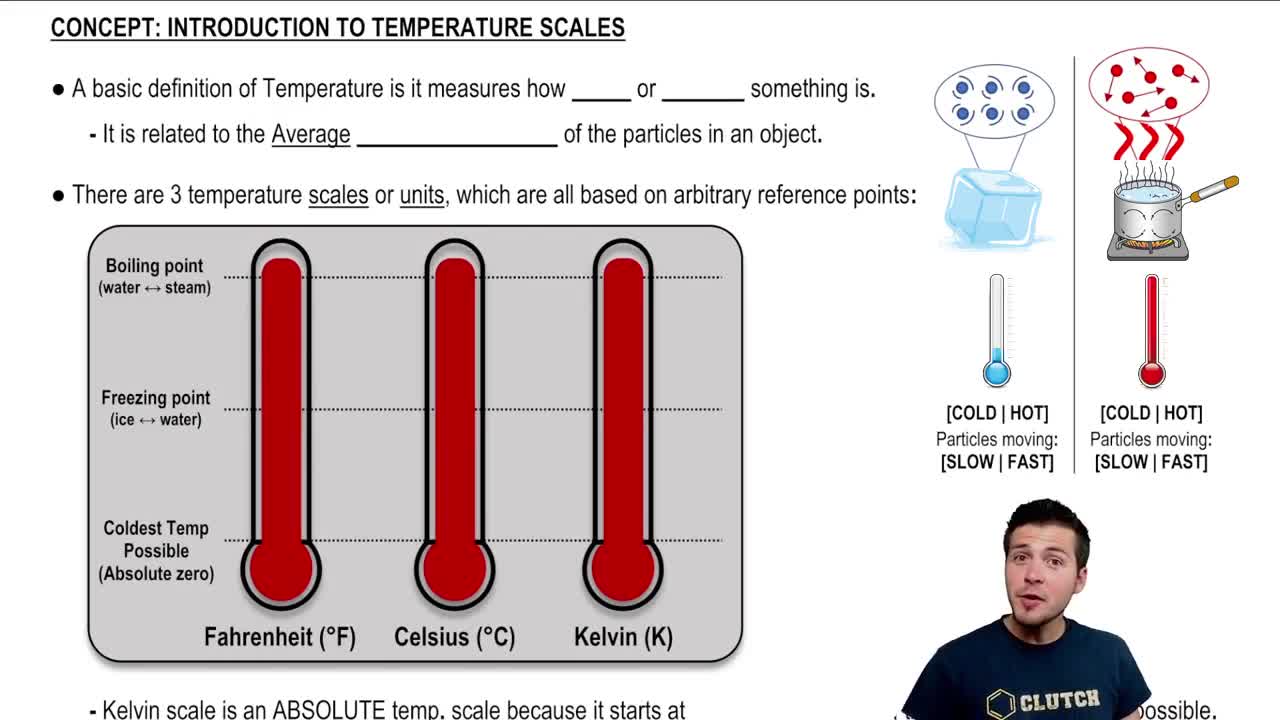
Introduction To Temperature Scales

Thermal Expansion

Thermal expansion refers to the increase in size of a material as its temperature rises. For metals, this can be quantified using the linear expansion formula ΔL = L0αΔT, where ΔL is the change in length, L0 is the original length, α is the coefficient of linear expansion, and ΔT is the change in temperature. This concept is essential for considering how the filament's dimensions affect its resistance.
Video consigliato:
Percorso guidato
05:21
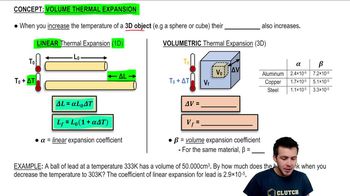
Volume Thermal Expansion

Resistivity and Its Temperature Dependence

Resistivity (ρ) is a material property that quantifies how strongly a given material opposes the flow of electric current. For metals, resistivity increases with temperature, typically modeled by ρ(T) = ρ0(1 + β(T - T0)), where β is the temperature coefficient of resistivity. This concept is important for calculating the percentage change in resistance due to changes in resistivity as the filament heats up.
Video consigliato:
Percorso guidato
04:54
Introduction To Temperature Scales
Pratica correlata