Ch. 27 - Magnetism
Giancoli Douglas - Physics for Scientists and Engineers 5th edition
Giancoli Douglas5th editionPhysics for Scientists and EngineersISBN: 9780137488179Non è quello che usi tu?Cambia libro di testo
Capitolo 26, Problema 41

A circular coil 18.0 cm in diameter and containing twelve loops lies flat on the ground. The Earth’s magnetic field at this location has magnitude 5.50 x 10⁻⁵ T and points into the Earth at an angle of 54.0° below a line pointing due north. If a 7.10-A clockwise current passes through the coil, (a) determine the torque on the coil; (b) which edge of the coil rises up : north, east, south, or west?

Guida verificata passo dopo passo
1
Step 1: Calculate the area of the circular coil. The diameter of the coil is given as 18.0 cm, so the radius is half of that. Use the formula for the area of a circle: A = πr², where r is the radius of the coil. Convert the radius to meters before substituting into the formula.
Step 2: Determine the magnetic moment of the coil. The magnetic moment (μ) is given by the formula μ = NIA, where N is the number of loops (12), I is the current (7.10 A), and A is the area of the coil calculated in Step 1.
Step 3: Calculate the torque on the coil. The torque (τ) is given by the formula τ = μBsinθ, where μ is the magnetic moment from Step 2, B is the Earth's magnetic field (5.50 × 10⁻⁵ T), and θ is the angle between the magnetic moment and the magnetic field (54.0°).
Step 4: Analyze the direction of the torque to determine which edge of the coil rises. Use the right-hand rule: point your fingers in the direction of the current in the coil (clockwise when viewed from above), and curl them in the direction of the magnetic field. The thumb will point in the direction of the torque, indicating which edge of the coil rises.
Step 5: Conclude which edge of the coil rises based on the torque direction. Consider the orientation of the coil (flat on the ground) and the direction of the Earth's magnetic field (pointing into the Earth at an angle). This will help determine whether the north, east, south, or west edge rises.

Risposta video verificata per un problema simile:

Questa soluzione video è stata consigliata dai nostri tutor come utile per risolvere questo problema.
Durata del video:
5m

Concetti chiave

Ecco i concetti essenziali che devi comprendere per rispondere correttamente alla domanda.

Torque in Magnetic Fields

Torque in a magnetic field is the rotational force experienced by a current-carrying coil placed in the field. It is calculated using the formula τ = n * I * A * B * sin(θ), where τ is torque, n is the number of loops, I is the current, A is the area of the coil, B is the magnetic field strength, and θ is the angle between the magnetic field and the normal to the coil's surface.
Video consigliato:
Percorso guidato
05:30
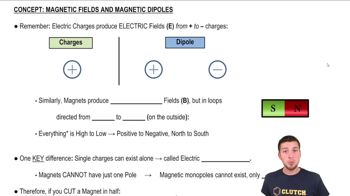
Magnetic Fields and Magnetic Dipoles

Magnetic Field Direction

The direction of the magnetic field is crucial for determining the behavior of the coil. In this scenario, the Earth's magnetic field points into the Earth at an angle, which affects the torque direction and the resulting motion of the coil. The right-hand rule can be used to visualize the interaction between the current direction and the magnetic field.
Video consigliato:
Percorso guidato
05:30
Magnetic Fields and Magnetic Dipoles

Right-Hand Rule

The right-hand rule is a mnemonic used to determine the direction of the torque and the magnetic force on a current-carrying conductor. By pointing the thumb of the right hand in the direction of the current and curling the fingers in the direction of the magnetic field, the palm indicates the direction of the force or torque acting on the coil. This rule is essential for predicting the coil's rotational movement.
Video consigliato:
Percorso guidato
19:11
Force on Moving Charges & Right Hand Rule
Pratica correlata
Domanda del libro di testo

How much work is required to rotate the current loop (Fig. 27–23) in a uniform magnetic field B→\(\overrightarrow{B}\) from (a) θ = 0° (μ→\(\overrightarrow{\mu}\) ∣∣ B→\(\overrightarrow{B}\)) to θ = 180°, (b) θ = 90° to θ = -90°.

1368
views

Domanda del libro di testo

\(\What\) is the value of q/m for a particle that moves in a circle of radius 8.0 mm in a 0.46-T magnetic field if a crossed 320-V/m electric field will make the path straight?

1311
views
Domanda del libro di testo

For a particle of mass m and charge q moving in a circular path in a magnetic field B, (a) show that its kinetic energy is proportional to r², the square of the radius of curvature of its path. Show that its angular momentum is L=qBr² , around the center of the circle.

1414
views
Domanda del libro di testo

A long copper strip is 3.0 cm wide and thick. When it carries a steady 42-A current in a 0.80-T magnetic field it produces a 6.5-μV Hall emf. Determine:

(a) the Hall field in the conductor;

(b) the drift speed of the conduction electrons;

(c) the density of free electrons in the metal.

1264
views
Domanda del libro di testo

A particle of charge q moves in a circular path of radius r in a uniform magnetic field B→\(\overrightarrow{B}\). If the magnitude of the magnetic field is doubled, and the kinetic energy of the particle remains constant, what happens to the angular momentum of the particle?

1838
views
Domanda del libro di testo

In a mass spectrometer, germanium atoms have radii of curvature equal to 21.0, 21.6, 21.9, 22.2, and 22.8 cm. The largest radius corresponds to an atomic mass of 76 u. What are the atomic masses of the other isotopes?

1291
views