Ch. 27 - Magnetism
Giancoli Douglas - Physics for Scientists and Engineers 5th edition
Giancoli Douglas5th editionPhysics for Scientists and EngineersISBN: 9780137488179Non è quello che usi tu?Cambia libro di testo
Capitolo 26, Problema 27

A particle of charge q moves in a circular path of radius r in a uniform magnetic field B→\(\overrightarrow{B}\). If the magnitude of the magnetic field is doubled, and the kinetic energy of the particle remains constant, what happens to the angular momentum of the particle?

Guida verificata passo dopo passo
1
The angular momentum of a particle in a magnetic field is given by the expression: L = mvr, where m is the mass of the particle, v is its velocity, and r is the radius of the circular path.
The radius of the circular motion in a magnetic field is determined by the balance of the centripetal force and the magnetic force: r = mv / (qB), where q is the charge of the particle and B is the magnetic field strength.
If the magnetic field strength B is doubled, the radius of the circular path becomes: r' = r / 2, since r is inversely proportional to B.
The kinetic energy of the particle remains constant, which means the velocity v does not change. Therefore, the angular momentum becomes: L' = mvr' = L / 2, where L is the original angular momentum.
Thus, the angular momentum of the particle is halved when the magnetic field strength is doubled, while keeping the kinetic energy constant.

Risposta video verificata per un problema simile:

Questa soluzione video è stata consigliata dai nostri tutor come utile per risolvere questo problema.
Durata del video:
5m

Concetti chiave

Ecco i concetti essenziali che devi comprendere per rispondere correttamente alla domanda.

Magnetic Force on a Charged Particle

When a charged particle moves in a magnetic field, it experiences a magnetic force that acts perpendicular to both the velocity of the particle and the direction of the magnetic field. This force causes the particle to move in a circular path, with the radius of the path determined by the balance between the magnetic force and the centripetal force required for circular motion.
Video consigliato:
Percorso guidato
09:08
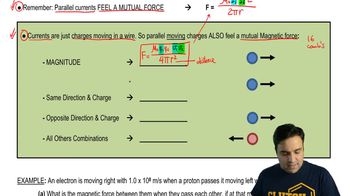
Magnetic Force Between Two Moving Charges

Kinetic Energy and Angular Momentum

The kinetic energy (KE) of a particle in circular motion is given by the equation KE = (1/2)mv², where m is the mass and v is the speed of the particle. Angular momentum (L) is defined as L = mvr, where r is the radius of the circular path. If the kinetic energy remains constant while the radius changes, the angular momentum will also change, as it is directly proportional to both the mass and the radius.
Video consigliato:
Percorso guidato
06:18
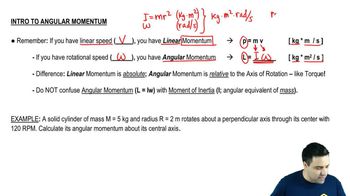
Intro to Angular Momentum

Effect of Magnetic Field on Motion

Doubling the magnitude of the magnetic field (B) affects the motion of the charged particle. According to the Lorentz force law, the magnetic force is proportional to the magnetic field strength. If the magnetic field is increased while keeping the kinetic energy constant, the speed of the particle must adjust, which in turn affects the radius of the circular path and consequently the angular momentum.
Video consigliato:
Percorso guidato
11:33
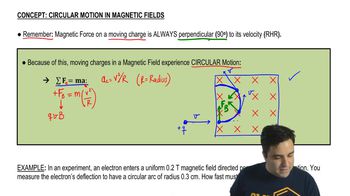
Circular Motion of Charges in Magnetic Fields
Pratica correlata
Domanda del libro di testo

How much work is required to rotate the current loop (Fig. 27–23) in a uniform magnetic field B→\(\overrightarrow{B}\) from (a) θ = 0° (μ→\(\overrightarrow{\mu}\) ∣∣ B→\(\overrightarrow{B}\)) to θ = 180°, (b) θ = 90° to θ = -90°.

1368
views

Domanda del libro di testo

(II) A current-carrying circular loop of wire (radius r, current I) is partially immersed in a magnetic field of constant magnitude B₀ directed out of the page as shown in Fig. 27–43. Determine the net force on the loop due to the field in terms of θ₀. (Note that θ₀ points to the dashed line, above which B = 0.)

1798
views
Domanda del libro di testo

For a particle of mass m and charge q moving in a circular path in a magnetic field B, (a) show that its kinetic energy is proportional to r², the square of the radius of curvature of its path. Show that its angular momentum is L=qBr² , around the center of the circle.

1414
views
Domanda del libro di testo

(III) A curved wire, connecting two points a and b, lies in a plane perpendicular to a uniform magnetic field B→\(\overrightarrow{B}\) and carries a current I. Show that the resultant magnetic force on the wire, no matter what its shape, is the same as that on a straight wire connecting the two points carrying the same current I. See Fig. 27–44.

1526
views
Domanda del libro di testo

A 720-KeV (kinetic energy) proton enters a 0.20-T field, in a plane perpendicular to the field. What is the radius of its path? See Section 23–8.

1505
views
Domanda del libro di testo

A circular coil 18.0 cm in diameter and containing twelve loops lies flat on the ground. The Earth’s magnetic field at this location has magnitude 5.50 x 10⁻⁵ T and points into the Earth at an angle of 54.0° below a line pointing due north. If a 7.10-A clockwise current passes through the coil, (a) determine the torque on the coil; (b) which edge of the coil rises up : north, east, south, or west?

1211
views