Ch. 27 - Magnetism
Giancoli Douglas - Physics for Scientists and Engineers 5th edition
Giancoli Douglas5th editionPhysics for Scientists and EngineersISBN: 9780137488179Non è quello che usi tu?Cambia libro di testo
Capitolo 26, Problema 30

For a particle of mass m and charge q moving in a circular path in a magnetic field B, (a) show that its kinetic energy is proportional to r², the square of the radius of curvature of its path. Show that its angular momentum is L=qBr² , around the center of the circle.

Guida verificata passo dopo passo
1
To solve part (a), start by recalling the force acting on a charged particle moving in a magnetic field. The magnetic force provides the centripetal force for circular motion: \( F = qvB = \frac{mv^2}{r} \), where \( v \) is the particle's velocity, \( r \) is the radius of the circular path, \( m \) is the mass, and \( q \) is the charge.
Rearrange the equation \( qvB = \frac{mv^2}{r} \) to solve for the velocity \( v \): \( v = \frac{qBr}{m} \).
The kinetic energy of the particle is given by \( KE = \frac{1}{2}mv^2 \). Substitute \( v = \frac{qBr}{m} \) into this expression: \( KE = \frac{1}{2}m\left(\frac{qBr}{m}\right)^2 \). Simplify to show that \( KE = \frac{q^2B^2r^2}{2m} \), which demonstrates that the kinetic energy is proportional to \( r^2 \).
For part (b), recall the definition of angular momentum \( L \) for a particle moving in a circular path: \( L = mvr \). Substitute \( v = \frac{qBr}{m} \) into this expression: \( L = m\left(\frac{qBr}{m}\right)r \).
Simplify the expression for \( L \): \( L = qBr^2 \). This shows that the angular momentum of the particle is \( L = qBr^2 \), as required.

Risposta video verificata per un problema simile:

Questa soluzione video è stata consigliata dai nostri tutor come utile per risolvere questo problema.
Durata del video:
4m

Concetti chiave

Ecco i concetti essenziali che devi comprendere per rispondere correttamente alla domanda.

Kinetic Energy in Circular Motion

In circular motion, the kinetic energy (KE) of a particle is given by the formula KE = (1/2)mv², where m is the mass and v is the velocity. For a charged particle moving in a magnetic field, the velocity can be related to the radius of curvature (r) and the magnetic field strength (B). As the radius increases, the velocity increases, leading to a proportional increase in kinetic energy, specifically showing that KE is proportional to r².
Video consigliato:
Percorso guidato
9:11
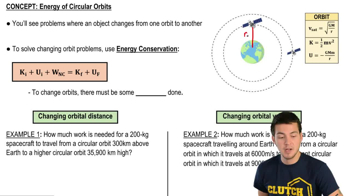
Energy of Circular Orbits

Angular Momentum

Angular momentum (L) is a measure of the rotational motion of an object and is defined as L = r × p, where r is the radius vector and p is the linear momentum. For a charged particle in a magnetic field, the angular momentum can be expressed as L = qBr², where q is the charge and B is the magnetic field strength. This relationship indicates that angular momentum increases with the square of the radius, emphasizing the influence of both charge and magnetic field on rotational dynamics.
Video consigliato:
Percorso guidato
06:18
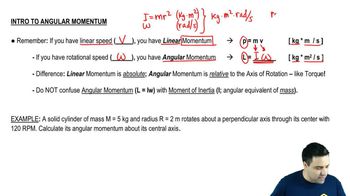
Intro to Angular Momentum

Magnetic Force and Circular Motion

When a charged particle moves in a magnetic field, it experiences a magnetic force that acts perpendicular to its velocity, causing it to follow a circular path. The magnetic force can be described by the Lorentz force equation, F = q(v × B). This force provides the necessary centripetal force for circular motion, which is essential for understanding how the radius of curvature and the magnetic field strength affect the particle's motion and energy.
Video consigliato:
Percorso guidato
11:33
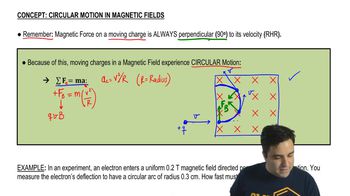
Circular Motion of Charges in Magnetic Fields
Pratica correlata
Domanda del libro di testo

How much work is required to rotate the current loop (Fig. 27–23) in a uniform magnetic field B→\(\overrightarrow{B}\) from (a) θ = 0° (μ→\(\overrightarrow{\mu}\) ∣∣ B→\(\overrightarrow{B}\)) to θ = 180°, (b) θ = 90° to θ = -90°.

1368
views

Domanda del libro di testo

\(\What\) is the value of q/m for a particle that moves in a circle of radius 8.0 mm in a 0.46-T magnetic field if a crossed 320-V/m electric field will make the path straight?

1311
views
Domanda del libro di testo

(III) A curved wire, connecting two points a and b, lies in a plane perpendicular to a uniform magnetic field B→\(\overrightarrow{B}\) and carries a current I. Show that the resultant magnetic force on the wire, no matter what its shape, is the same as that on a straight wire connecting the two points carrying the same current I. See Fig. 27–44.

1526
views
Domanda del libro di testo

A particle of charge q moves in a circular path of radius r in a uniform magnetic field B→\(\overrightarrow{B}\). If the magnitude of the magnetic field is doubled, and the kinetic energy of the particle remains constant, what happens to the angular momentum of the particle?

1838
views
Domanda del libro di testo

A 720-KeV (kinetic energy) proton enters a 0.20-T field, in a plane perpendicular to the field. What is the radius of its path? See Section 23–8.

1505
views
Domanda del libro di testo

A circular coil 18.0 cm in diameter and containing twelve loops lies flat on the ground. The Earth’s magnetic field at this location has magnitude 5.50 x 10⁻⁵ T and points into the Earth at an angle of 54.0° below a line pointing due north. If a 7.10-A clockwise current passes through the coil, (a) determine the torque on the coil; (b) which edge of the coil rises up : north, east, south, or west?

1211
views