
Ch. 29 - Electromagnetic Induction and Faraday's Law
Giancoli Douglas - Physics for Scientists and Engineers 5th edition
Giancoli Douglas5th editionPhysics for Scientists and EngineersISBN: 9780137488179Non è quello che usi tu?Cambia libro di testo
Capitolo 28, Problema 44

A transformer is designed to change 117 V into 13,500 V, and there are 172 turns in the primary coil. How many turns are in the secondary coil?

Guida verificata passo dopo passo
1
Understand the relationship between the voltage and the number of turns in a transformer. This is governed by the transformer equation: VsVp = NsNp, where Vs and Vp are the secondary and primary voltages, and Ns and Np are the number of turns in the secondary and primary coils, respectively.
Substitute the given values into the transformer equation. The primary voltage Vp is 117 V, the secondary voltage Vs is 13,500 V, and the number of turns in the primary coil Np is 172.
Rearrange the equation to solve for the number of turns in the secondary coil Ns. The equation becomes: Ns = VsVp × Np.
Perform the substitution: Ns = 13500117 × 172. This sets up the calculation for the number of turns in the secondary coil.
Simplify the expression to find the value of Ns. This involves dividing 13,500 by 117 and then multiplying the result by 172.

Concetti chiave

Ecco i concetti essenziali che devi comprendere per rispondere correttamente alla domanda.

Transformers

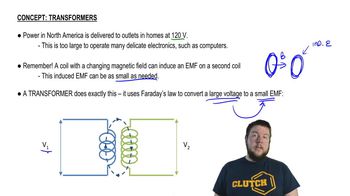
Transformers are electrical devices that transfer electrical energy between two or more circuits through electromagnetic induction. They consist of primary and secondary coils, where the voltage change is proportional to the ratio of the number of turns in each coil. This principle allows transformers to either step up (increase) or step down (decrease) voltage levels.
Video consigliato:

Turns Ratio

The turns ratio in a transformer is the ratio of the number of turns in the primary coil to the number of turns in the secondary coil. It is a critical factor in determining how the voltage changes between the primary and secondary sides. The formula for the turns ratio is given by Vp/Vs = Np/Ns, where V is voltage, N is the number of turns, and the subscripts p and s refer to primary and secondary, respectively.
Video consigliato:
Percorso guidato
05:32
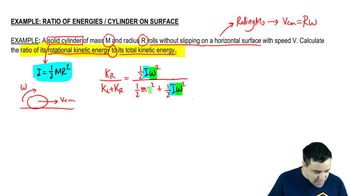
Ratio of energies of cylinder on surface

Voltage Transformation

Voltage transformation in a transformer is governed by the relationship between the primary and secondary voltages and their respective turns. If a transformer steps up voltage, the secondary voltage is greater than the primary voltage, and vice versa for a step-down transformer. This relationship is essential for calculating the number of turns in the secondary coil when the primary voltage and turns are known.
Video consigliato:
Pratica correlata
Domanda del libro di testo

(III) Suppose a conducting rod (mass m, resistance R) rests on two frictionless and resistanceless parallel rails a distance ℓ apart in a uniform magnetic field B→\(\overrightarrow{B}\) (⊥ to the rails and to the rod) as in Fig. 29–53. At t = 0, the rod is at rest and a source of emf is connected to the points a and b. Determine the speed of the rod as a function of time if (a) the source puts out a constant current I, (b) the source puts out a constant emf ε₀. (c) Does the rod reach a terminal speed in either case? If so, what is it?

143
views
Domanda del libro di testo

Neon signs require 12 kV for their operation. To operate from a 240-V line, what must be the ratio of secondary to primary turns of the transformer? What would the voltage output be if the transformer were connected in reverse?

1591
views
Domanda del libro di testo

A model-train transformer plugs into 120-V ac and draws 0.35 A while supplying 6.5 A to the train.

(a) What voltage is present across the tracks?

(b) Is the transformer step-up or step-down?

1494
views
Domanda del libro di testo

(II) A conducting rod rests on two long frictionless parallel rails in a magnetic field B→\(\overrightarrow{B}\) (⊥ to the rails and rod) as in Fig. 29–53. (a) If the rails are horizontal and the rod is given an initial push, will the rod travel at constant speed even though a magnetic field is present? (b) Suppose at t = 0, when the rod has speed v = v0, the two rails are connected electrically by a wire from point a to point b. Assuming the rod has resistance R and the rails have negligible resistance, determine the speed of the rod as a function of time. Discuss your answer.

1698
views
Domanda del libro di testo

A transformer has 680 turns in the primary coil and 85 in the secondary coil. What kind of transformer is this, and by what factor does it change the voltage? By what factor does it change the current?

1569
views
Domanda del libro di testo

A circular loop in the plane of the paper lies in a 0.65-T uniform magnetic field pointing into the paper. The loop’s diameter changes from 20.0 cm to 8.0 cm in 0.50 s. What is (a) the direction of the induced current, (b) the magnitude of the average induced emf, and (c) the average induced current if the coil resistance is 2.5Ω?

1650
views