Ch. 35 - Diffraction
Giancoli Douglas - Physics for Scientists and Engineers 5th edition
Giancoli Douglas5th editionPhysics for Scientists and EngineersISBN: 9780137488179Non è quello che usi tu?Cambia libro di testo
Capitolo 34, Problema 45

Red laser light from a He–Ne laser (λ = 632.8 nm) creates a second-order fringe at 53.2° after passing through a grating. What is the wavelength λ of light that creates a first-order fringe at 21.2°?

Guida verificata passo dopo passo
1
Step 1: Recall the diffraction grating equation: d \, \(\sin\) \(\theta\) = m \, \(\lambda\), where d is the spacing between adjacent slits in the grating, \(\theta\) is the diffraction angle, m is the order of the fringe, and \(\lambda\) is the wavelength of the light.
Step 2: Use the given information for the red laser light to calculate the grating spacing d. For the second-order fringe (m = 2) at an angle of \(\theta\) = 53.2^\(\circ\) and wavelength \(\lambda\) = 632.8 \, \(\text{nm}\), rearrange the equation to solve for d: d = \(\frac{m \, \lambda}{\sin \theta}\).
Step 3: Substitute the known values for the red laser light into the equation to calculate d. This value of d will be the same for the second part of the problem, as the grating is unchanged.
Step 4: Use the diffraction grating equation again to find the wavelength \(\lambda\) of the light that creates a first-order fringe (m = 1) at an angle of \(\theta\) = 21.2^\(\circ\). Rearrange the equation to solve for \(\lambda\): \(\lambda\) = \(\frac{d \, \sin \theta}{m}\).
Step 5: Substitute the value of d (calculated in Step 3) and the given values for m and \(\theta\) into the equation to find the wavelength \(\lambda\) of the light.

Risposta video verificata per un problema simile:

Questa soluzione video è stata consigliata dai nostri tutor come utile per risolvere questo problema.
Durata del video:
4m

Concetti chiave

Ecco i concetti essenziali che devi comprendere per rispondere correttamente alla domanda.

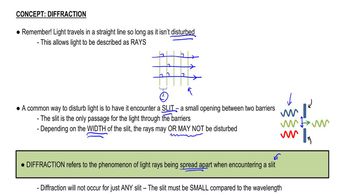
Diffraction Grating

A diffraction grating is an optical component with a periodic structure that disperses light into its component wavelengths. When light passes through or reflects off a grating, it creates interference patterns due to the superposition of light waves. The angles at which these patterns occur depend on the wavelength of the light and the spacing of the grating lines.
Video consigliato:

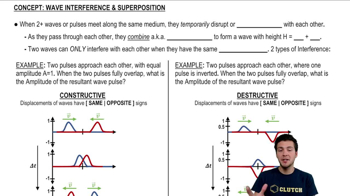
Interference Patterns

Interference patterns arise when two or more coherent light waves overlap, resulting in regions of constructive and destructive interference. In the context of diffraction gratings, these patterns are characterized by bright and dark fringes, where the position of the fringes is determined by the wavelength of the light and the angle of observation.
Video consigliato:
Percorso guidato
03:47
Wave Interference & Superposition

Order of Fringes

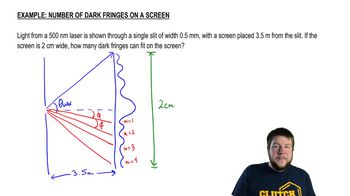
The order of fringes refers to the integer multiples of the wavelength that correspond to specific angles of constructive interference in a diffraction pattern. The first-order fringe (m=1) occurs at a certain angle for a given wavelength, while higher-order fringes (m=2, m=3, etc.) occur at angles that are multiples of the first-order angle, allowing for the calculation of unknown wavelengths based on known angles.
Video consigliato:
Percorso guidato
09:05
Number of Dark Fringes on a Screen
Pratica correlata