
Ch. 35 - Diffraction
Giancoli Douglas - Physics for Scientists and Engineers 5th edition
Giancoli Douglas5th editionPhysics for Scientists and EngineersISBN: 9780137488179Non è quello che usi tu?Cambia libro di testo
Capitolo 34, Problema 41

Show that the second- and third-order spectra of white light produced by a diffraction grating always overlap. What wavelengths overlap?

Guida verificata passo dopo passo
1
Step 1: Begin by understanding the diffraction grating equation, which is \( m \lambda = d \sin \theta \), where \( m \) is the order of the spectrum, \( \lambda \) is the wavelength of light, \( d \) is the spacing between adjacent slits in the grating, and \( \theta \) is the diffraction angle.
Step 2: To determine the overlap between the second-order (\( m = 2 \)) and third-order (\( m = 3 \)) spectra, consider the condition where a wavelength \( \lambda_2 \) in the second-order spectrum coincides with a wavelength \( \lambda_3 \) in the third-order spectrum. This means \( 2 \lambda_2 = 3 \lambda_3 \).
Step 3: Solve for \( \lambda_3 \) in terms of \( \lambda_2 \) using the relationship \( \lambda_3 = \frac{2}{3} \lambda_2 \). This indicates that wavelengths in the third-order spectrum are fractions of the wavelengths in the second-order spectrum.
Step 4: Recognize that white light contains a continuous range of wavelengths. For any wavelength \( \lambda_2 \) in the second-order spectrum, there exists a corresponding wavelength \( \lambda_3 \) in the third-order spectrum that satisfies the overlap condition. This overlap occurs because the diffraction grating equation is linear with respect to \( \lambda \).
Step 5: Conclude that the overlapping wavelengths are those that satisfy \( \lambda_3 = \frac{2}{3} \lambda_2 \). For example, if \( \lambda_2 \) is 600 nm in the second-order spectrum, \( \lambda_3 \) would be 400 nm in the third-order spectrum, demonstrating the overlap.

Concetti chiave

Ecco i concetti essenziali che devi comprendere per rispondere correttamente alla domanda.

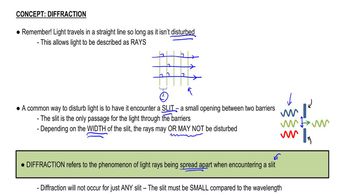
Diffraction Grating

A diffraction grating is an optical component with a periodic structure that disperses light into its component wavelengths. When light passes through or reflects off the grating, it creates interference patterns due to the superposition of light waves. The angles at which constructive interference occurs depend on the wavelength of the light and the spacing of the grating lines, which is crucial for understanding the spectra produced.
Video consigliato:

Order of Spectrum

The order of a spectrum refers to the different sets of wavelengths produced by a diffraction grating. The first-order spectrum corresponds to the first set of angles where constructive interference occurs, while the second- and third-order spectra correspond to subsequent sets. These orders can overlap for certain wavelengths, leading to the same angle of diffraction for different orders, which is essential for analyzing the overlap in the question.
Video consigliato:
Percorso guidato
06:06
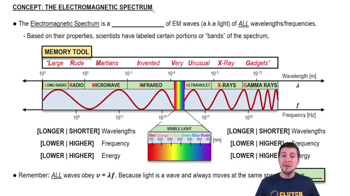
The Electromagnetic Spectrum

Wavelength Overlap

Wavelength overlap occurs when different orders of a diffraction grating produce the same angle of diffraction for specific wavelengths. This phenomenon can be mathematically described using the grating equation, which relates the angle of diffraction to the wavelength and the grating spacing. Understanding which wavelengths overlap between the second and third orders is key to solving the problem presented in the question.
Video consigliato:
Percorso guidato
05:42
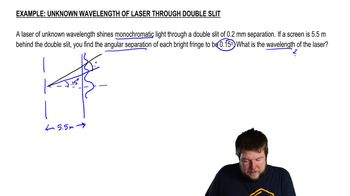
Unknown Wavelength of Laser through Double Slit
Pratica correlata
Domanda del libro di testo

(II) White light passes through a 640-slit/ mm diffraction grating. First-order and second-order visible spectra (“rainbows”) appear on the wall 32 cm away as shown in Fig. 35–40. Determine the widths ℓ₁ and ℓ₂ of the two “rainbows” (400 nm to 700 nm). In which order is the “rainbow” dispersed over a larger distance?

60
views
Domanda del libro di testo

A diffraction grating has 6.5 x 10⁵ slits/m. Find the angular spread in the second-order spectrum between red light of wavelength 7.0 x 10⁻⁷ m and blue light of wavelength 4.5 x 10⁻⁷ m.

82
views
Domanda del libro di testo

When driving at night, your eyes’ pupils have dilated to a 7.5-mm diameter. If your vision is diffraction limited, what would be the greatest distance at which you could resolve the two headlights of an oncoming car, which are spaced 1.5 m apart? Assume a wavelength of 550 nm for the light.

69
views
Domanda del libro di testo

Red laser light from a He–Ne laser (λ = 632.8 nm) creates a second-order fringe at 53.2° after passing through a grating. What is the wavelength λ of light that creates a first-order fringe at 21.2°?

1389
views
Domanda del libro di testo

Suppose the angles measured in Problem 42 were produced when the spectrometer (but not the source) was submerged in water. What then would be the wavelengths (in air)?

1417
views
Domanda del libro di testo

A 3800-slit/cm grating produces a third-order fringe at a 35.0° angle. What wavelength of light is being used?

82
views