Ch. 35 - Diffraction
Giancoli Douglas - Physics for Scientists and Engineers 5th edition
Giancoli Douglas5th editionPhysics for Scientists and EngineersISBN: 9780137488179Non è quello che usi tu?Cambia libro di testo
Capitolo 34, Problema 43

Suppose the angles measured in Problem 42 were produced when the spectrometer (but not the source) was submerged in water. What then would be the wavelengths (in air)?

Guida verificata passo dopo passo
1
Understand the problem: The spectrometer is submerged in water, which changes the effective wavelength of light due to the refractive index of water. The goal is to determine the wavelengths of light in air, given the angles measured in water.
Recall the relationship between wavelength in a medium and wavelength in air: \( \lambda_{\text{medium}} = \frac{\lambda_{\text{air}}}{n} \), where \( n \) is the refractive index of the medium (water in this case). Rearrange this equation to find \( \lambda_{\text{air}} = \lambda_{\text{medium}} \cdot n \).
Determine the refractive index of water: The refractive index of water is approximately \( n = 1.33 \). This value will be used to convert the wavelength from water to air.
Use the diffraction grating equation to relate the measured angles to the wavelength in water: \( d \sin \theta = m \lambda_{\text{medium}} \), where \( d \) is the grating spacing, \( \theta \) is the diffraction angle, \( m \) is the diffraction order, and \( \lambda_{\text{medium}} \) is the wavelength in water. Solve for \( \lambda_{\text{medium}} \) using the measured angles.
Substitute \( \lambda_{\text{medium}} \) into the equation \( \lambda_{\text{air}} = \lambda_{\text{medium}} \cdot n \) to calculate the wavelength in air. This will give the final result for the wavelengths in air.

Risposta video verificata per un problema simile:

Questa soluzione video è stata consigliata dai nostri tutor come utile per risolvere questo problema.
Durata del video:
2m

Concetti chiave

Ecco i concetti essenziali che devi comprendere per rispondere correttamente alla domanda.

Refraction of Light

Refraction occurs when light passes from one medium to another, changing its speed and direction. In this case, when light travels from air into water, it slows down and bends, which affects the angles measured by the spectrometer. Understanding Snell's Law, which relates the angles of incidence and refraction to the indices of refraction of the two media, is crucial for calculating the new angles.
Video consigliato:
Percorso guidato
03:46
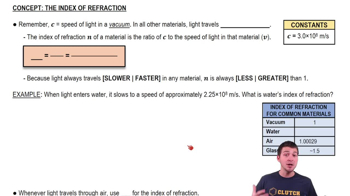
Index of Refraction

Wavelength in Different Media

The wavelength of light changes when it moves between different media due to variations in the speed of light. In water, the wavelength is shorter than in air because light travels slower in water. This concept is essential for determining the wavelengths in air based on the measurements taken in water, as the relationship between wavelength, frequency, and speed must be considered.
Video consigliato:
Percorso guidato
05:42
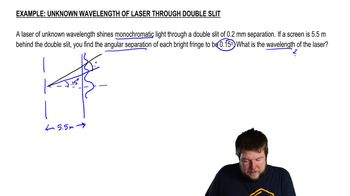
Unknown Wavelength of Laser through Double Slit

Spectrometer Functionality

A spectrometer is an instrument used to measure the properties of light over a specific portion of the electromagnetic spectrum. It can determine the wavelengths of light by analyzing the angles at which different wavelengths are refracted. Understanding how a spectrometer operates, including its calibration and the impact of environmental factors like the medium it is submerged in, is vital for interpreting the results accurately.
Video consigliato:
Percorso guidato
20:32
Mass Spectrometers