Ch 01: Concepts of Motion
Knight Calc - Physics for Scientists and Engineers 5th Edition
Knight Calc5th EditionPhysics for Scientists and EngineersISBN: 9780137344796Non è quello che usi tu?Cambia libro di testo
Capitolo 1, Problema 56

An intravenous saline drip has 9.0 g of sodium chloride per liter of water. By definition, 1 mL = 1 cm3. Express the salt concentration in kg/m3.

Guida verificata passo dopo passo
1
Step 1: Start by converting the given mass of sodium chloride from grams to kilograms. Since 1 kg = 1000 g, divide the given mass (9.0 g) by 1000 to express it in kilograms.
Step 2: Recognize that the volume of the solution is given as 1 liter, and by definition, 1 liter = 1000 mL = 1000 cm³ = 0.001 m³. Convert the volume to cubic meters (m³).
Step 3: Use the formula for concentration, which is defined as mass per unit volume: \( \text{Concentration} = \frac{\text{Mass}}{\text{Volume}} \). Substitute the mass in kilograms and the volume in cubic meters into this formula.
Step 4: Perform the division to calculate the concentration in \( \text{kg/m}^3 \). Ensure the units are consistent throughout the calculation.
Step 5: Verify the units of the final result to confirm that the concentration is expressed in \( \text{kg/m}^3 \), which is the desired unit for this problem.

Risposta video verificata per un problema simile:

Questa soluzione video è stata consigliata dai nostri tutor come utile per risolvere questo problema.
Durata del video:
1m

Concetti chiave

Ecco i concetti essenziali che devi comprendere per rispondere correttamente alla domanda.

Concentration

Concentration refers to the amount of a substance (solute) present in a given volume of solution. It is commonly expressed in various units, such as grams per liter (g/L) or kilograms per cubic meter (kg/m³). Understanding concentration is essential for determining how much solute is dissolved in a solvent, which is crucial in fields like chemistry and medicine.
Video consigliato:
Percorso guidato
05:32
Find Magnetic Field By Two Concentric Loops

Unit Conversion

Unit conversion is the process of converting a quantity expressed in one set of units to another. In this context, converting grams per liter to kilograms per cubic meter involves recognizing that 1 g = 0.001 kg and 1 L = 0.001 m³. Mastery of unit conversion is vital for accurately interpreting and communicating scientific measurements.
Video consigliato:
Percorso guidato
07:46
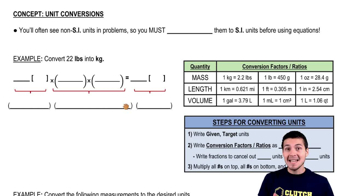
Unit Conversions

Density of Water

The density of water is typically taken as 1 kg/L, which means that 1 liter of water has a mass of 1 kilogram. This property is important when calculating concentrations, as it allows for straightforward conversions between volume and mass. In the context of saline solutions, knowing the density helps in understanding how solutes interact with solvents.
Video consigliato:
Percorso guidato
8:13
Intro to Density