Ch 01: Concepts of Motion
Knight Calc - Physics for Scientists and Engineers 5th Edition
Knight Calc5th EditionPhysics for Scientists and EngineersISBN: 9780137344796Non è quello che usi tu?Cambia libro di testo
Capitolo 1, Problema 51c

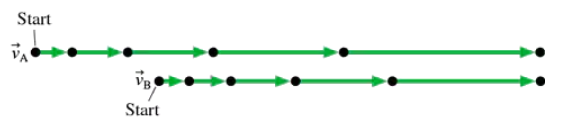
Problems 49, 50, 51, and 52 show a partial motion diagram. For each: Draw a pictorial representation for your problem.

Guida verificata passo dopo passo
1
Understand the problem: A motion diagram is a series of images or dots that represent the position of an object at equal time intervals. The task is to create a pictorial representation based on the given motion diagram.
Step 1: Analyze the motion diagram provided. Look at the spacing between the dots to determine the type of motion (e.g., constant velocity, acceleration, or deceleration). Larger spacing indicates faster motion, while smaller spacing indicates slower motion.
Step 2: Identify the key elements of the motion. For example, note the starting position, direction of motion, and any changes in speed or direction.
Step 3: Draw a coordinate system for your pictorial representation. Label the axes appropriately (e.g., position vs. time or a physical representation of the path).
Step 4: Represent the object's motion on the diagram. Use arrows to indicate the direction of motion and adjust the length of the arrows to reflect changes in speed. Include any relevant details, such as initial and final positions, and label them clearly.

Risposta video verificata per un problema simile:

Questa soluzione video è stata consigliata dai nostri tutor come utile per risolvere questo problema.
Durata del video:
5m

Concetti chiave

Ecco i concetti essenziali che devi comprendere per rispondere correttamente alla domanda.

Motion Diagrams

Motion diagrams are visual representations that illustrate the position of an object at various points in time. They typically consist of a series of dots or arrows that indicate the object's trajectory and velocity. Understanding motion diagrams is essential for analyzing the kinematics of an object, as they help visualize how an object moves through space over time.
Video consigliato:
Percorso guidato
08:07
Work and PV Diagrams

Pictorial Representation

A pictorial representation is a visual depiction of a scenario or problem, often used to simplify complex concepts. In physics, this can include sketches, diagrams, or graphs that convey information about the motion, forces, or energy involved in a situation. Creating a clear pictorial representation aids in understanding the relationships between different physical quantities and enhances problem-solving skills.
Video consigliato:
Percorso guidato
04:25
Sound Intensity Level and the Decibel Scale

Kinematics

Kinematics is the branch of physics that deals with the motion of objects without considering the forces that cause the motion. It involves analyzing parameters such as displacement, velocity, and acceleration. A solid grasp of kinematics is crucial for interpreting motion diagrams and creating accurate pictorial representations, as it provides the foundational principles needed to describe how objects move.
Video consigliato:
Percorso guidato
08:25
Kinematics Equations