Ch 01: Concepts of Motion
Knight Calc - Physics for Scientists and Engineers 5th Edition
Knight Calc5th EditionPhysics for Scientists and EngineersISBN: 9780137344796Non è quello che usi tu?Cambia libro di testo
Capitolo 1, Problema 21

Draw a pictorial representation for the following problem. Do not solve the problem. What acceleration does a rocket need to reach a speed of 200 m/s at a height of 1.0 km?

Guida verificata passo dopo passo
1
Start by identifying the key elements of the problem: the rocket's final speed (v = 200 m/s), the height it reaches (h = 1.0 km or 1000 m), and the unknown acceleration (a). Note that the initial speed (u) is not explicitly mentioned, so assume it starts from rest (u = 0 m/s).
Draw a vertical axis to represent the motion of the rocket. Label the starting point at the bottom as the initial position (y₀ = 0 m) and the final position at the top as y = 1000 m.
Indicate the initial velocity (u = 0 m/s) at the bottom of the diagram and the final velocity (v = 200 m/s) at the top of the diagram. Use arrows to show the direction of motion (upward).
Label the unknown acceleration (a) on the diagram, pointing in the same direction as the motion (upward). This represents the constant acceleration the rocket needs to achieve the given final speed at the specified height.
Include the relevant kinematic equation that relates the given quantities: v2 = u2 + 2as, where v is the final velocity, u is the initial velocity, a is the acceleration, and s is the displacement (height in this case). This equation will be used to solve for the acceleration later.

Risposta video verificata per un problema simile:

Questa soluzione video è stata consigliata dai nostri tutor come utile per risolvere questo problema.
Durata del video:
3m

Concetti chiave

Ecco i concetti essenziali che devi comprendere per rispondere correttamente alla domanda.

Acceleration

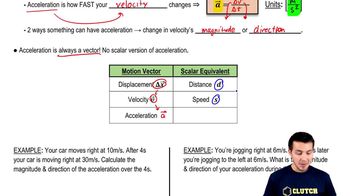
Acceleration is the rate of change of velocity of an object with respect to time. It is a vector quantity, meaning it has both magnitude and direction. In the context of the rocket problem, acceleration is crucial for determining how quickly the rocket can increase its speed to reach the desired velocity of 200 m/s.
Video consigliato:
Percorso guidato
05:47
Intro to Acceleration

Kinematics

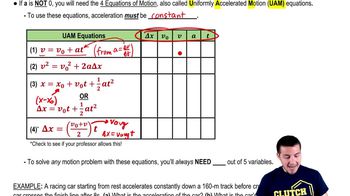
Kinematics is the branch of mechanics that deals with the motion of objects without considering the forces that cause the motion. It involves concepts such as displacement, velocity, and acceleration. Understanding kinematics is essential for analyzing the rocket's motion as it ascends to a height of 1.0 km and reaches the target speed.
Video consigliato:
Percorso guidato
08:25
Kinematics Equations

Height and Gravity

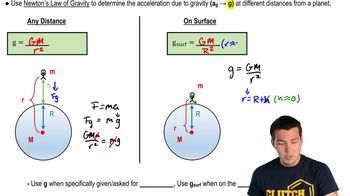
Height refers to the vertical distance an object is above a reference point, typically the ground. In this problem, the rocket's height of 1.0 km is significant because it affects the gravitational force acting on the rocket. As the rocket ascends, the gravitational force influences its acceleration and overall motion, making it a key factor in the analysis.
Video consigliato:
Percorso guidato
05:20
Acceleration Due to Gravity