Ch 01: Concepts of Motion
Knight Calc - Physics for Scientists and Engineers 5th Edition
Knight Calc5th EditionPhysics for Scientists and EngineersISBN: 9780137344796Non è quello che usi tu?Cambia libro di testo
Capitolo 1, Problema 17

Your roommate drops a tennis ball from a third-story balcony. It hits the sidewalk and bounces as high as the second story. Draw a complete motion diagram of the tennis ball from the time it is released until it reaches the maximum height on its bounce. Be sure to determine and show the acceleration at the lowest point.

Guida verificata passo dopo passo
1
Step 1: Begin by identifying the key phases of the tennis ball's motion: (1) free fall from the third-story balcony, (2) collision with the sidewalk, and (3) upward motion after the bounce until it reaches the maximum height near the second story.
Step 2: For the free fall phase, note that the ball is accelerating downward due to gravity. Represent this in the motion diagram with velocity vectors increasing in length as the ball approaches the sidewalk. The acceleration vector (gravity) points downward throughout this phase.
Step 3: At the lowest point (the collision with the sidewalk), the ball experiences a rapid change in velocity due to the force exerted by the sidewalk. The acceleration at this point is upward and much larger in magnitude than gravity, as it reverses the ball's direction. Indicate this with a short upward acceleration vector at the lowest point in the motion diagram.
Step 4: For the upward motion after the bounce, the ball slows down as it rises due to gravity acting downward. Represent this in the motion diagram with velocity vectors decreasing in length as the ball approaches its maximum height. The acceleration vector (gravity) continues to point downward throughout this phase.
Step 5: At the maximum height of the bounce (near the second story), the ball's velocity is momentarily zero before it begins to fall again. Indicate this in the motion diagram with no velocity vector at the peak and a downward acceleration vector due to gravity.

Risposta video verificata per un problema simile:

Questa soluzione video è stata consigliata dai nostri tutor come utile per risolvere questo problema.
Durata del video:
3m

Concetti chiave

Ecco i concetti essenziali che devi comprendere per rispondere correttamente alla domanda.

Free Fall

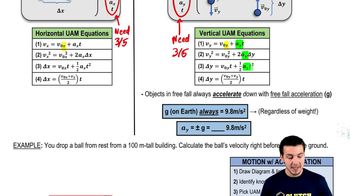
Free fall refers to the motion of an object under the influence of gravity alone, with no other forces acting on it. In this scenario, the tennis ball is dropped from a height, and it accelerates downward at a constant rate of approximately 9.81 m/s², which is the acceleration due to gravity. This concept is crucial for understanding the ball's motion as it falls towards the ground.
Video consigliato:
Percorso guidato
08:36
Vertical Motion & Free Fall

Kinetic and Potential Energy

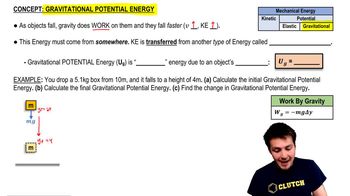
Kinetic energy is the energy of an object in motion, while potential energy is the stored energy based on an object's height above the ground. As the tennis ball falls, its potential energy decreases while its kinetic energy increases. Upon bouncing, the ball converts kinetic energy back into potential energy as it rises, reaching a maximum height before falling again.
Video consigliato:
Percorso guidato
06:35
Gravitational Potential Energy

Acceleration at the Lowest Point

At the lowest point of the bounce, the tennis ball experiences a change in acceleration. Just before it hits the ground, it has maximum downward velocity, and the acceleration due to gravity is still acting on it. Upon impact, the ball decelerates rapidly as it compresses and then accelerates upward, indicating a change in direction of the acceleration vector, which is essential for understanding the dynamics of the bounce.
Video consigliato:
Percorso guidato
03:42
Torque & Acceleration of a Point Mass