Ch 01: Concepts of Motion
Knight Calc - Physics for Scientists and Engineers 5th Edition
Knight Calc5th EditionPhysics for Scientists and EngineersISBN: 9780137344796Non è quello che usi tu?Cambia libro di testo
Capitolo 1, Problema 10b

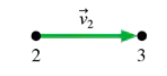
FIGURE EX1.10 shows two dots of a motion diagram and vector. Copy this figure, then add dot 4 and the next velocity vector if the acceleration vector at dot 3 points left.

Guida verificata passo dopo passo
1
Step 1: Analyze the given motion diagram. Dot 3 represents the current position, and the velocity vector V₃ points to the right, indicating motion in that direction. The acceleration vector at dot 3 is specified to point left, meaning the object is decelerating as it moves to the right.
Step 2: Understand the effect of the leftward acceleration. Since acceleration is opposite to the direction of velocity, the magnitude of the velocity will decrease as the object moves from dot 3 to dot 4.
Step 3: Predict the position of dot 4. Since the object is still moving to the right but slowing down, dot 4 will be placed to the right of dot 3, but closer to dot 3 compared to the distance between dots 2 and 3.
Step 4: Draw the velocity vector at dot 4. The velocity vector at dot 4 will still point to the right but will be shorter in length compared to V₃, reflecting the reduced speed due to the leftward acceleration.
Step 5: Add the acceleration vector at dot 3 to the diagram. The acceleration vector should be drawn pointing left at dot 3 to indicate the deceleration effect.

Risposta video verificata per un problema simile:

Questa soluzione video è stata consigliata dai nostri tutor come utile per risolvere questo problema.
Durata del video:
2m

Concetti chiave

Ecco i concetti essenziali che devi comprendere per rispondere correttamente alla domanda.

Motion Diagrams

Motion diagrams visually represent the position of an object at various time intervals. Each dot in the diagram indicates the object's position at a specific moment, while arrows represent velocity vectors, showing the direction and magnitude of motion. Understanding motion diagrams is crucial for analyzing how an object's position changes over time and how it relates to velocity and acceleration.
Video consigliato:
Percorso guidato
08:07
Work and PV Diagrams

Velocity and Acceleration

Velocity is a vector quantity that describes the rate of change of an object's position, including both speed and direction. Acceleration, also a vector, indicates the rate of change of velocity over time. In the context of the question, the relationship between velocity and acceleration is essential, as acceleration can affect the object's speed and direction, particularly when it points in the opposite direction of the velocity.
Video consigliato:
Percorso guidato
11:21
Rotational Velocity & Acceleration

Vector Addition

Vector addition is the process of combining two or more vectors to determine a resultant vector. This is particularly important in physics when analyzing motion, as both velocity and acceleration are vectors. In the given scenario, understanding how to add the acceleration vector to the existing velocity vector will help determine the new velocity vector for dot 4, especially since the acceleration is directed opposite to the velocity.
Video consigliato:
Percorso guidato
07:30
Vector Addition By Components
Pratica correlata
Domanda del libro di testo

A speed skater accelerates from rest and then keeps skating at a constant speed. Draw a complete motion diagram of the skater.

2144
views

Domanda del libro di testo

You drop a soccer ball from your third-story balcony. Use the particle model to draw a motion diagram showing the ball's position and average velocity vectors from the time you release the ball until the instant it touches the ground.

2394
views
Domanda del libro di testo

FIGURE EX1.9 shows five points of a motion diagram. Use Tactics Box 1.2 to find the average acceleration vectors at points 1, 2, and 3. Draw the completed motion diagram showing velocity vectors and acceleration vectors.

2768
views
1
rank
Domanda del libro di testo

Your roommate drops a tennis ball from a third-story balcony. It hits the sidewalk and bounces as high as the second story. Draw a complete motion diagram of the tennis ball from the time it is released until it reaches the maximum height on its bounce. Be sure to determine and show the acceleration at the lowest point.

1960
views
Domanda del libro di testo

FIGURE EX1.8 shows the first three points of a motion diagram. Is the object's average speed between points 1 and 2 greater than, less than, or equal to its average speed between points 0 and 1? Explain how you can tell.

1869
views
Domanda del libro di testo

A bowling ball rolls up an incline and then onto a smooth, level surface. Draw a complete motion diagram of the bowling ball. Don't try to find the acceleration vector at the point where the motion changes direction; that's an issue for Chapter 4.

1834
views