Ch 03: Vectors and Coordinate Systems
Knight Calc - Physics for Scientists and Engineers 5th Edition
Knight Calc5th EditionPhysics for Scientists and EngineersISBN: 9780137344796Non è quello che usi tu?Cambia libro di testo
Capitolo 3, Problema 5

A position vector in the first quadrant has an x-component of 6 m and a magnitude of 10 m. What is the value of its y-component?

Guida verificata passo dopo passo
1
Step 1: Recall the formula for the magnitude of a vector in two dimensions: \( \text{magnitude} = \sqrt{x^2 + y^2} \), where \(x\) is the x-component and \(y\) is the y-component.
Step 2: Substitute the given values into the formula. The magnitude is \(10\, \text{m}\) and the x-component is \(6\, \text{m}\). This gives \(10 = \sqrt{6^2 + y^2}\).
Step 3: Square both sides of the equation to eliminate the square root. This results in \(10^2 = 6^2 + y^2\), or \(100 = 36 + y^2\).
Step 4: Rearrange the equation to isolate \(y^2\). Subtract \(36\) from both sides: \(y^2 = 100 - 36\).
Step 5: Solve for \(y\) by taking the square root of \(y^2\). Since the vector is in the first quadrant, \(y\) must be positive. Thus, \(y = \sqrt{64}\).

Risposta video verificata per un problema simile:

Questa soluzione video è stata consigliata dai nostri tutor come utile per risolvere questo problema.
Durata del video:
1m

Concetti chiave

Ecco i concetti essenziali che devi comprendere per rispondere correttamente alla domanda.

Position Vector

A position vector represents the location of a point in space relative to an origin. It is typically expressed in terms of its components along the coordinate axes, such as x and y in a two-dimensional Cartesian system. The magnitude of the position vector is the straight-line distance from the origin to the point, while the components indicate how far the point is in each direction.
Video consigliato:
Percorso guidato
07:07
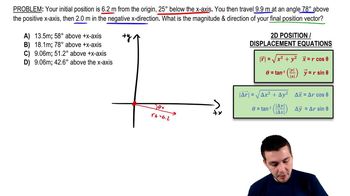
Final Position Vector

Magnitude of a Vector

The magnitude of a vector is a measure of its length or size, calculated using the Pythagorean theorem in two dimensions. For a vector with components x and y, the magnitude is given by the formula √(x² + y²). This concept is crucial for understanding how the components relate to the overall size of the vector, especially when one component is known.
Video consigliato:
Percorso guidato
03:59
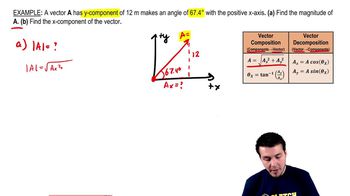
Calculating Magnitude & Components of a Vector

Pythagorean Theorem

The Pythagorean theorem is a fundamental principle in geometry that relates the lengths of the sides of a right triangle. It states that in a right triangle, the square of the length of the hypotenuse (the side opposite the right angle) is equal to the sum of the squares of the lengths of the other two sides. This theorem is essential for calculating the unknown component of a vector when the magnitude and one component are known.
Video consigliato:
Percorso guidato
13:46
Parallel Axis Theorem