Ch 03: Vectors and Coordinate Systems
Knight Calc - Physics for Scientists and Engineers 5th Edition
Knight Calc5th EditionPhysics for Scientists and EngineersISBN: 9780137344796Non è quello che usi tu?Cambia libro di testo
Capitolo 3, Problema 6b

Draw each of the following vectors. Then find its x- and y-components. v=(440m/s,30∘below the positive x-axis)\(\mathbf{v}\) = (440 \, \(\text{m/s}\), 30^\(\circ\) \, \(\text{below the positive }\) x\(\text{-axis}\))

Guida verificata passo dopo passo
1
Step 1: Understand the problem. The vector v = 440 m/s is given with a direction of 30 degrees below the positive x-axis. This means the angle is measured clockwise from the positive x-axis. We need to find the x- and y-components of this vector.
Step 2: Recall the formulas for the components of a vector. The x-component of a vector is given by v_x = v * cos(θ), and the y-component is given by v_y = v * sin(θ). Here, θ is the angle the vector makes with the positive x-axis.
Step 3: Note the direction of the components. Since the angle is below the x-axis, the y-component will be negative. The x-component will remain positive because the vector points in the positive x-direction.
Step 4: Substitute the given values into the formulas. Use v = 440 m/s and θ = 30 degrees. For the x-component: v_x = 440 * cos(30). For the y-component: v_y = 440 * sin(30).
Step 5: Simplify the trigonometric expressions. Use the known values of cos(30) = √3/2 and sin(30) = 1/2 to express the components. This gives v_x = 440 * (√3/2) and v_y = 440 * (-1/2).

Risposta video verificata per un problema simile:

Questa soluzione video è stata consigliata dai nostri tutor come utile per risolvere questo problema.
Durata del video:
2m

Concetti chiave

Ecco i concetti essenziali che devi comprendere per rispondere correttamente alla domanda.

Vectors

Vectors are quantities that have both magnitude and direction. In physics, they are often represented graphically as arrows, where the length of the arrow indicates the magnitude and the direction of the arrow indicates the direction of the vector. Understanding vectors is essential for analyzing motion and forces in two or three dimensions.
Video consigliato:
Percorso guidato
06:44
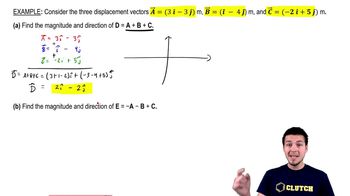
Adding 3 Vectors in Unit Vector Notation

Components of a Vector

The components of a vector are the projections of that vector along the axes of a coordinate system, typically the x-axis and y-axis. For a vector given in polar form (magnitude and angle), the x-component can be found using the cosine of the angle, while the y-component is found using the sine of the angle. This breakdown allows for easier calculations in physics problems involving motion and forces.
Video consigliato:
Percorso guidato
07:30
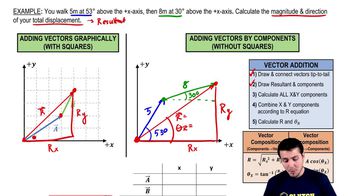
Vector Addition By Components

Trigonometric Functions

Trigonometric functions, such as sine and cosine, relate the angles of a triangle to the ratios of its sides. In the context of vectors, these functions are used to resolve a vector into its components. For example, if a vector makes an angle θ with the x-axis, the x-component is found using cos(θ) and the y-component using sin(θ), which is fundamental in analyzing vector quantities in physics.
Video consigliato:
Percorso guidato
08:30
Intro to Wave Functions