Ch 03: Vectors and Coordinate Systems
Knight Calc - Physics for Scientists and Engineers 5th Edition
Knight Calc5th EditionPhysics for Scientists and EngineersISBN: 9780137344796Non è quello che usi tu?Cambia libro di testo
Capitolo 3, Problema 24c

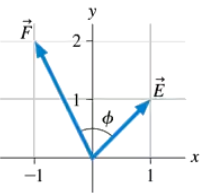
Use components to determine the magnitude and direction of G = E+F.

Guida verificata passo dopo passo
1
Break down the given vectors E and F into their components. For each vector, use the equations: x=magnitude⋅cos(θ) for the x-component and y=magnitud⋅sin(θ) for the y-component, where θ is the angle of the vector with respect to the positive x-axis.
Add the x-components of vectors E and F to find the x-component of the resultant vector G: Gx=Ex+Fx.
Add the y-components of vectors E and F to find the y-component of the resultant vector G: Gy=Ey+Fy.
Determine the magnitude of the resultant vector G using the Pythagorean theorem: G=Gx2+Gy2.
Find the direction (angle) of the resultant vector G with respect to the positive x-axis using the inverse tangent function: θ=tan⁻1(GyGx). Ensure the angle is expressed in the correct quadrant based on the signs of Gx and Gy.

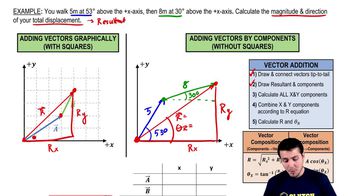
Risposta video verificata per un problema simile:

Questa soluzione video è stata consigliata dai nostri tutor come utile per risolvere questo problema.
Durata del video:
6m

Concetti chiave

Ecco i concetti essenziali che devi comprendere per rispondere correttamente alla domanda.

Vector Addition

Vector addition is the process of combining two or more vectors to determine a resultant vector. This involves adding the corresponding components of the vectors, typically represented in a Cartesian coordinate system. The magnitude and direction of the resultant vector can be found using the Pythagorean theorem and trigonometric functions, which are essential for understanding how forces interact in physics.
Video consigliato:
Percorso guidato
07:30
Vector Addition By Components

Components of a Vector

Vectors can be broken down into their components along the axes of a coordinate system, usually the x and y axes. Each vector can be expressed as a sum of its horizontal (x) and vertical (y) components, allowing for easier calculations in physics. Understanding how to resolve vectors into components is crucial for accurately determining the resultant vector's magnitude and direction.
Video consigliato:
Percorso guidato
07:30
Vector Addition By Components

Resultant Vector

The resultant vector is the single vector that has the same effect as two or more vectors acting together. It is obtained by vector addition and represents both the total magnitude and direction of the combined vectors. In the context of forces, the resultant vector indicates the net force acting on an object, which is vital for analyzing motion and equilibrium in physics.
Video consigliato: