Ch 03: Vectors and Coordinate Systems
Knight Calc - Physics for Scientists and Engineers 5th Edition
Knight Calc5th EditionPhysics for Scientists and EngineersISBN: 9780137344796Non è quello che usi tu?Cambia libro di testo
Capitolo 3, Problema 23c

The position of a particle as a function of time is given by r→\(\overrightarrow{r}\) = ( 5.0î +4.0ĵ )t² m where t is in seconds. What is the particle's speed at t = 0, 2, and 5 s?

Guida verificata passo dopo passo
1
Step 1: Understand the problem. The position vector of the particle is given as 𝓇 = (5.0î + 4.0ĵ)t² m. To find the speed of the particle at specific times (t = 0, 2, and 5 s), we first need to calculate the velocity vector by differentiating the position vector with respect to time.
Step 2: Differentiate the position vector 𝓇 with respect to time t to find the velocity vector 𝓋. Using the formula 𝓋 = d𝓇/dt, we get: 𝓋 = d/dt[(5.0î + 4.0ĵ)t²] = 2t(5.0î + 4.0ĵ).
Step 3: Write the velocity vector explicitly as a function of time: 𝓋 = (10.0t)î + (8.0t)ĵ m/s. This represents the velocity of the particle at any time t.
Step 4: Calculate the magnitude of the velocity vector to find the speed. The speed is given by the formula |𝓋| = √((10.0t)² + (8.0t)²). Simplify the expression: |𝓋| = √(100.0t² + 64.0t²) = √(164.0t²) = t√164.0 m/s.
Step 5: Substitute the given times (t = 0, 2, and 5 s) into the speed formula |𝓋| = t√164.0 to find the particle's speed at each time. For example, at t = 2 s, the speed is |𝓋| = 2√164.0 m/s. Repeat this substitution for t = 0 and t = 5 s to find the respective speeds.

Risposta video verificata per un problema simile:

Questa soluzione video è stata consigliata dai nostri tutor come utile per risolvere questo problema.
Durata del video:
3m

Concetti chiave

Ecco i concetti essenziali che devi comprendere per rispondere correttamente alla domanda.

Position Vector

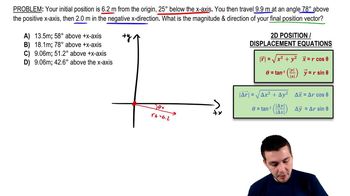
The position vector describes the location of a particle in space as a function of time. In this case, the position vector 𝓇 = (5.0î + 4.0ĵ)t² m indicates that the particle's position changes quadratically with time, where î and ĵ are unit vectors in the x and y directions, respectively.
Video consigliato:
Percorso guidato
07:07
Final Position Vector

Velocity

Velocity is the rate of change of the position vector with respect to time. It is calculated by taking the derivative of the position vector with respect to time. For the given position function, the velocity vector can be found by differentiating 𝓇 with respect to t, which will provide the particle's speed and direction at any given time.
Video consigliato:
Percorso guidato
7:27
Escape Velocity

Speed

Speed is a scalar quantity that represents the magnitude of the velocity vector. It is calculated as the square root of the sum of the squares of the components of the velocity vector. By evaluating the velocity at specific times (t = 0, 2, and 5 s) and then calculating the magnitude, we can determine the particle's speed at those moments.
Video consigliato:
Percorso guidato
07:59
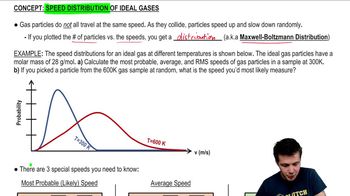
Speed Distribution & Special Speeds of Ideal Gases