Ch 03: Vectors and Coordinate Systems
Knight Calc - Physics for Scientists and Engineers 5th Edition
Knight Calc5th EditionPhysics for Scientists and EngineersISBN: 9780137344796Non è quello che usi tu?Cambia libro di testo
Capitolo 3, Problema 10a

Draw each of the following vectors, label an angle that specifies the vector's direction, and then find the vector's magnitude and direction. A = 3.0i + 7.0j

Guida verificata passo dopo passo
1
Step 1: Understand the vector notation. The vector A = 3.0i + 7.0j is expressed in terms of its components along the x-axis (i) and y-axis (j). Here, 3.0 is the x-component, and 7.0 is the y-component.
Step 2: Draw the vector. On a Cartesian coordinate system, plot the point (3.0, 7.0). Start at the origin (0, 0) and draw an arrow pointing to this point. This arrow represents the vector A.
Step 3: Label the angle that specifies the vector's direction. The angle θ is measured counterclockwise from the positive x-axis to the vector. To find θ, use the formula θ = arctan(y/x), where y = 7.0 and x = 3.0.
Step 4: Calculate the magnitude of the vector. The magnitude is the length of the vector and can be found using the Pythagorean theorem: |A| = √(x² + y²). Substitute x = 3.0 and y = 7.0 into the formula.
Step 5: Combine the results. The magnitude |A| and the direction θ together fully describe the vector. Express the direction in degrees or radians, depending on the context, and ensure the magnitude is labeled with appropriate units.

Risposta video verificata per un problema simile:

Questa soluzione video è stata consigliata dai nostri tutor come utile per risolvere questo problema.
Durata del video:
2m

Concetti chiave

Ecco i concetti essenziali che devi comprendere per rispondere correttamente alla domanda.

Vector Representation

Vectors are quantities that have both magnitude and direction, represented in a coordinate system. In this case, the vector A = 3.0i + 7.0j is expressed in terms of its components along the x-axis (i) and y-axis (j). The coefficients indicate how far the vector extends in each direction, allowing for a graphical representation in a Cartesian plane.
Video consigliato:
Percorso guidato
06:44
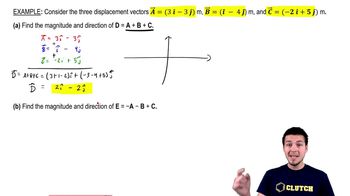
Adding 3 Vectors in Unit Vector Notation

Magnitude of a Vector

The magnitude of a vector is a measure of its length, calculated using the Pythagorean theorem. For vector A = 3.0i + 7.0j, the magnitude is found by taking the square root of the sum of the squares of its components: |A| = √(3.0² + 7.0²). This value provides a scalar quantity that represents how strong or large the vector is.
Video consigliato:
Percorso guidato
03:59
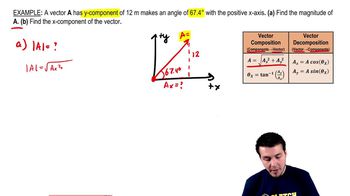
Calculating Magnitude & Components of a Vector

Direction of a Vector

The direction of a vector is specified by the angle it makes with a reference axis, typically the positive x-axis. This angle can be calculated using the arctangent function: θ = arctan(y/x), where y and x are the vector's components. For vector A, the direction can be determined by finding the angle corresponding to the components 3.0 and 7.0, which indicates the vector's orientation in the plane.
Video consigliato:
Percorso guidato
06:44
Adding 3 Vectors in Unit Vector Notation