Ch 03: Vectors and Coordinate Systems
Knight Calc - Physics for Scientists and Engineers 5th Edition
Knight Calc5th EditionPhysics for Scientists and EngineersISBN: 9780137344796Non è quello che usi tu?Cambia libro di testo
Capitolo 3, Problema 11b

Draw each of the following vectors, label an angle that specifies the vector's direction, then find its magnitude and direction. r = (-2.0i - 1.0j) cm

Guida verificata passo dopo passo
1
Step 1: Understand the vector notation. The vector r = (-2.0i - 1.0j) cm is expressed in terms of its components along the x-axis (i) and y-axis (j). Here, -2.0 cm is the x-component, and -1.0 cm is the y-component.
Step 2: Draw the vector on a Cartesian coordinate system. Start at the origin (0, 0). Move 2.0 cm to the left along the x-axis (negative direction) and then 1.0 cm downward along the y-axis (negative direction). Label the vector r and mark the angle it makes with the positive x-axis.
Step 3: Calculate the magnitude of the vector using the Pythagorean theorem. The magnitude |r| is given by the formula: 2.02+1.02. Substitute the values and simplify.
Step 4: Determine the direction of the vector. The angle θ (relative to the positive x-axis) can be found using the formula: θ=tan-1(-1.0-2.0). Note that both components are negative, so the vector lies in the third quadrant.
Step 5: Adjust the angle to reflect its position in the third quadrant. Since the arctangent function typically gives angles between -90° and 90°, add 180° to the result to find the correct angle in standard position. Express the magnitude and direction in the final form.

Risposta video verificata per un problema simile:

Questa soluzione video è stata consigliata dai nostri tutor come utile per risolvere questo problema.
Durata del video:
6m

Concetti chiave

Ecco i concetti essenziali che devi comprendere per rispondere correttamente alla domanda.

Vector Representation

Vectors are quantities that have both magnitude and direction, represented in a coordinate system. In this case, the vector r = (-2.0i - 1.0j) cm is expressed in terms of its components along the x-axis (i) and y-axis (j). The negative signs indicate that the vector points in the negative x and y directions, respectively.
Video consigliato:
Percorso guidato
06:44
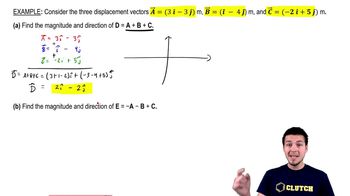
Adding 3 Vectors in Unit Vector Notation

Magnitude of a Vector

The magnitude of a vector is a measure of its length and can be calculated using the Pythagorean theorem. For the vector r = (-2.0i - 1.0j) cm, the magnitude is found by taking the square root of the sum of the squares of its components: |r| = √((-2.0)² + (-1.0)²) cm, which gives the total distance represented by the vector.
Video consigliato:
Percorso guidato
03:59
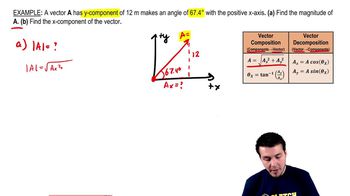
Calculating Magnitude & Components of a Vector

Direction of a Vector

The direction of a vector is often specified by an angle relative to a reference axis, typically the positive x-axis. This angle can be calculated using the arctangent function: θ = arctan(y/x). For the vector r = (-2.0i - 1.0j) cm, the angle will be in the third quadrant, reflecting its negative components, and can be expressed in degrees or radians.
Video consigliato:
Percorso guidato
06:44
Adding 3 Vectors in Unit Vector Notation