Ch 03: Vectors and Coordinate Systems
Knight Calc - Physics for Scientists and Engineers 5th Edition
Knight Calc5th EditionPhysics for Scientists and EngineersISBN: 9780137344796Non è quello che usi tu?Cambia libro di testo
Capitolo 3, Problema 12a

Let A = 4i - 2j, B = -3i + 5j, and C = A + B. Write vector C in component form.

Guida verificata passo dopo passo
1
Step 1: Understand the problem. You are given two vectors A and B in component form: A = 4i - 2j and B = -3i + 5j. The task is to find the resultant vector C, which is the sum of A and B, and express it in component form.
Step 2: Recall the rule for vector addition. To add two vectors in component form, you add their respective components. For example, if A = ai + bj and B = ci + dj, then A + B = (a + c)i + (b + d)j.
Step 3: Apply the rule to the given vectors. For the i-components, add the coefficients of i from A and B: 4 (from A) + (-3) (from B). For the j-components, add the coefficients of j from A and B: -2 (from A) + 5 (from B).
Step 4: Write the resultant vector C in component form. After performing the addition, C will be expressed as (sum of i-components)i + (sum of j-components)j.
Step 5: Verify your work by double-checking the addition of the components to ensure accuracy. This ensures that the resultant vector C is correctly calculated in component form.

Risposta video verificata per un problema simile:

Questa soluzione video è stata consigliata dai nostri tutor come utile per risolvere questo problema.
Durata del video:
2m

Concetti chiave

Ecco i concetti essenziali che devi comprendere per rispondere correttamente alla domanda.

Vector Addition

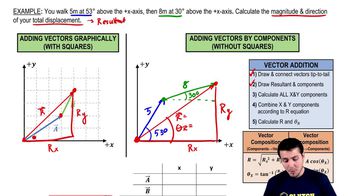
Vector addition involves combining two or more vectors to produce a resultant vector. This is done by adding their corresponding components. For example, if vector A has components (Ax, Ay) and vector B has components (Bx, By), the resultant vector C will have components (Ax + Bx, Ay + By).
Video consigliato:
Percorso guidato
07:30
Vector Addition By Components

Component Form of a Vector

The component form of a vector expresses it in terms of its horizontal and vertical components, typically represented as A = xi + yj, where x is the horizontal component and y is the vertical component. This form allows for easier calculations, especially in vector addition and subtraction.
Video consigliato:
Percorso guidato
07:30
Vector Addition By Components

Unit Vectors

Unit vectors are vectors with a magnitude of one, used to indicate direction. The standard unit vectors in two-dimensional space are i (representing the x-direction) and j (representing the y-direction). They are essential for expressing vectors in component form and simplifying vector operations.
Video consigliato: