Ch 03: Vectors and Coordinate Systems
Knight Calc - Physics for Scientists and Engineers 5th Edition
Knight Calc5th EditionPhysics for Scientists and EngineersISBN: 9780137344796Non è quello che usi tu?Cambia libro di testo
Capitolo 3, Problema 15b

Let A = 4i - 2j, B = -3i + 5j, and D = A - B. Draw a coordinate system and on it show vectors A, B, and D.

Guida verificata passo dopo passo
1
Start by understanding the given vectors: A = 4i - 2j and B = -3i + 5j. These are expressed in unit vector notation, where 'i' represents the x-direction and 'j' represents the y-direction.
To find vector D, use the vector subtraction formula: D = A - B. Subtract the corresponding components of vectors A and B. For the x-components: 4 - (-3). For the y-components: -2 - 5.
Simplify the subtraction to determine the components of vector D. The x-component becomes 4 + 3, and the y-component becomes -2 - 5. This gives the final form of vector D in terms of its components.
Once you have the components of D, represent it in unit vector notation as D = (x-component)i + (y-component)j. This will give you the complete expression for vector D.
To draw the coordinate system, plot vectors A, B, and D on a Cartesian plane. Start each vector at the origin, and use their components to determine their endpoints. For example, vector A starts at (0, 0) and ends at (4, -2). Similarly, plot B and D using their respective components.

Risposta video verificata per un problema simile:

Questa soluzione video è stata consigliata dai nostri tutor come utile per risolvere questo problema.
Durata del video:
5m

Concetti chiave

Ecco i concetti essenziali che devi comprendere per rispondere correttamente alla domanda.

Vector Representation

Vectors are quantities that have both magnitude and direction, represented in a coordinate system using components along the axes. In this case, vectors A and B are expressed in terms of their i (horizontal) and j (vertical) components, allowing for easy visualization and manipulation in a two-dimensional space.
Video consigliato:
Percorso guidato
06:44
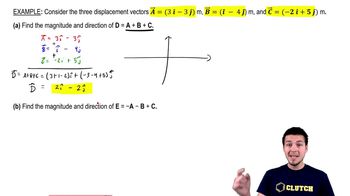
Adding 3 Vectors in Unit Vector Notation

Vector Addition

Vector addition involves combining two or more vectors to find a resultant vector. This is done by adding their corresponding components. For example, to find vector D, we subtract vector B from vector A, which involves subtracting the i and j components separately to determine the new vector's components.
Video consigliato:
Percorso guidato
07:30
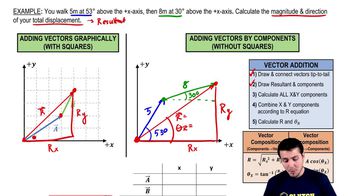
Vector Addition By Components

Coordinate System

A coordinate system provides a framework for locating points and vectors in space. In two dimensions, the Cartesian coordinate system uses perpendicular axes (x and y) to define positions. When drawing vectors A, B, and D, the coordinate system helps visualize their directions and magnitudes relative to each other.
Video consigliato:
Percorso guidato
05:17
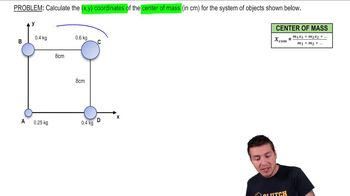
Coordinates of Center of Mass of 4 objects