Ch 03: Vectors and Coordinate Systems
Knight Calc - Physics for Scientists and Engineers 5th Edition
Knight Calc5th EditionPhysics for Scientists and EngineersISBN: 9780137344796Non è quello che usi tu?Cambia libro di testo
Capitolo 3, Problema 16a

Let A = 4i - 2j, B = -3i + 5j, and F = A - 4B. Write vector F in component form.

Guida verificata passo dopo passo
1
Step 1: Understand the problem. You are given two vectors, A and B, in component form, and you need to calculate a new vector F using the formula F = A - 4B. This involves vector subtraction and scalar multiplication.
Step 2: Write down the components of vector A and vector B. Vector A = 4i - 2j can be expressed as (4, -2), and vector B = -3i + 5j can be expressed as (-3, 5).
Step 3: Perform scalar multiplication on vector B. Multiply each component of vector B by the scalar 4: 4 * (-3) = -12 for the i-component, and 4 * 5 = 20 for the j-component. This gives 4B = (-12, 20).
Step 4: Subtract 4B from A to find vector F. Subtract the corresponding components: For the i-component, 4 - (-12) = 4 + 12 = 16. For the j-component, -2 - 20 = -22. This gives F = (16, -22).
Step 5: Write vector F in component form. The final result is F = 16i - 22j, which is expressed as (16, -22) in component form.

Risposta video verificata per un problema simile:

Questa soluzione video è stata consigliata dai nostri tutor come utile per risolvere questo problema.
Durata del video:
3m

Concetti chiave

Ecco i concetti essenziali che devi comprendere per rispondere correttamente alla domanda.

Vector Addition and Subtraction

Vector addition and subtraction involve combining vectors by adding or subtracting their corresponding components. For example, if vector A has components (Ax, Ay) and vector B has components (Bx, By), the resultant vector C = A + B will have components (Ax + Bx, Ay + By). This principle is essential for calculating vector F in the given problem.
Video consigliato:
Percorso guidato
05:58
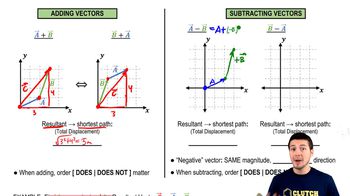
Subtracting Vectors Graphically

Component Form of a Vector

The component form of a vector expresses it in terms of its horizontal and vertical components, typically represented as A = xi + yj, where x is the horizontal component and y is the vertical component. This format allows for easier manipulation and calculation of vectors, particularly when performing operations like addition or subtraction.
Video consigliato:
Percorso guidato
07:30
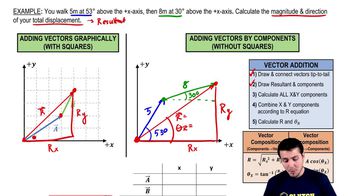
Vector Addition By Components

Scalar Multiplication of Vectors

Scalar multiplication involves multiplying a vector by a scalar (a real number), which scales the vector's magnitude without changing its direction. For instance, if vector B is multiplied by a scalar k, the new vector kB will have components (kBx, kBy). This concept is crucial for determining vector F, as it requires multiplying vector B by -4 before performing the subtraction.
Video consigliato:
Percorso guidato
04:06
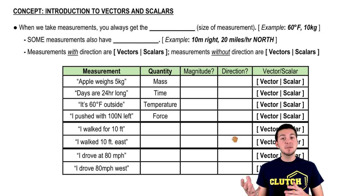
Introduction to Vectors and Scalars