Ch 03: Vectors and Coordinate Systems
Knight Calc - Physics for Scientists and Engineers 5th Edition
Knight Calc5th EditionPhysics for Scientists and EngineersISBN: 9780137344796Non è quello che usi tu?Cambia libro di testo
Capitolo 3, Problema 21a

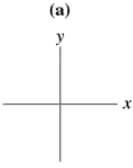
Let B→\(\overrightarrow{B}\) = (5.0 m, 30 degrees counterclockwise from vertically up). Find the x- and y-components of B→\(\overrightarrow{B}\) in each of the two coordinate systems shown in FIGURE EX3.21.

Guida verificata passo dopo passo
1
Step 1: Identify the vector B = (5.0 m, 30 degrees counterclockwise from vertically up). In the normal coordinate system, the vertical axis is the y-axis, and the horizontal axis is the x-axis. In the tilted coordinate system, the axes are rotated by 15 degrees counterclockwise.
Step 2: For the normal coordinate system, resolve the vector B into its x- and y-components using trigonometric functions. The x-component is given by B_x = B * sin(θ), and the y-component is given by B_y = B * cos(θ), where θ = 30 degrees.
Step 3: For the tilted coordinate system, adjust the angle of the vector relative to the tilted axes. The angle of B relative to the tilted y-axis is θ_tilted = 30 degrees - 15 degrees = 15 degrees. Use the same trigonometric functions to resolve the vector: B_x_tilted = B * sin(θ_tilted) and B_y_tilted = B * cos(θ_tilted).
Step 4: Substitute the magnitude of B (5.0 m) and the angles (30 degrees for normal, 15 degrees for tilted) into the trigonometric equations to calculate the components. Ensure you use the correct trigonometric values for sin and cos of the angles.
Step 5: Interpret the results. The components in the normal coordinate system will align with the standard x- and y-axes, while the components in the tilted coordinate system will align with the rotated axes. This demonstrates how vector components depend on the orientation of the coordinate system.

Risposta video verificata per un problema simile:

Questa soluzione video è stata consigliata dai nostri tutor come utile per risolvere questo problema.
Durata del video:
7m

Concetti chiave

Ecco i concetti essenziali che devi comprendere per rispondere correttamente alla domanda.

Vector Components

Vector components are the projections of a vector along the axes of a coordinate system. For a vector B, its components can be calculated using trigonometric functions: the x-component is found using Bx = B * cos(θ) and the y-component using By = B * sin(θ), where θ is the angle the vector makes with the reference axis.
Video consigliato:
Percorso guidato
07:30
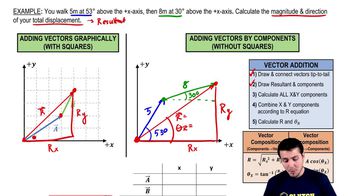
Vector Addition By Components

Coordinate Systems

Coordinate systems provide a framework for describing the position and direction of vectors. In this problem, two systems are used: a normal Cartesian system and a tilted system, which is rotated by 15 degrees. The choice of coordinate system affects how the components of the vector are calculated, as the angle θ will differ based on the orientation of the axes.
Video consigliato:
Percorso guidato
05:17
Coordinates of Center of Mass of 4 objects

Trigonometric Functions

Trigonometric functions, such as sine and cosine, relate the angles of a triangle to the ratios of its sides. They are essential for resolving vectors into components. In this context, they help determine how much of the vector B lies in the x and y directions, depending on the angle of the vector relative to the coordinate axes.
Video consigliato:
Percorso guidato
08:30
Intro to Wave Functions