Ch 03: Vectors and Coordinate Systems
Knight Calc - Physics for Scientists and Engineers 5th Edition
Knight Calc5th EditionPhysics for Scientists and EngineersISBN: 9780137344796Non è quello che usi tu?Cambia libro di testo
Capitolo 3, Problema 23b

The position of a particle as a function of time is given by r→\(\overrightarrow{r}\) = ( 5.0î +4.0ĵ )t² m where t is in seconds. Find an expression for the particle's velocity v→\(\overrightarrow{v}\) as a function of time.

Guida verificata passo dopo passo
1
Step 1: Recall that velocity is the time derivative of position. To find the velocity vector \( \mathbf{v}(t) \), differentiate the position vector \( \mathbf{r}(t) \) with respect to time \( t \). The position vector is given as \( \mathbf{r}(t) = (5.0 \mathbf{i} + 4.0 \mathbf{j}) t^2 \).
Step 2: Apply the derivative to each component of \( \mathbf{r}(t) \). For the \( \mathbf{i} \)-component, differentiate \( 5.0 t^2 \) with respect to \( t \). For the \( \mathbf{j} \)-component, differentiate \( 4.0 t^2 \) with respect to \( t \).
Step 3: Use the power rule for differentiation, which states \( \frac{d}{dt}(t^n) = n t^{n-1} \). For the \( \mathbf{i} \)-component, \( \frac{d}{dt}(5.0 t^2) = 2 \cdot 5.0 \cdot t = 10.0 t \). For the \( \mathbf{j} \)-component, \( \frac{d}{dt}(4.0 t^2) = 2 \cdot 4.0 \cdot t = 8.0 t \).
Step 4: Combine the differentiated components to form the velocity vector. The velocity vector is \( \mathbf{v}(t) = (10.0 t \mathbf{i} + 8.0 t \mathbf{j}) \).
Step 5: Write the final expression for the velocity vector as \( \mathbf{v}(t) = t (10.0 \mathbf{i} + 8.0 \mathbf{j}) \), which shows the velocity as a function of time.

Risposta video verificata per un problema simile:

Questa soluzione video è stata consigliata dai nostri tutor come utile per risolvere questo problema.
Durata del video:
2m

Concetti chiave

Ecco i concetti essenziali che devi comprendere per rispondere correttamente alla domanda.

Position Vector

The position vector describes the location of a particle in space as a function of time. In this case, the position vector 𝓇 = (5.0î + 4.0ĵ)t² m indicates that the particle's position changes quadratically with time, with components in the x and y directions represented by the coefficients of î and ĵ, respectively.
Video consigliato:
Percorso guidato
07:07
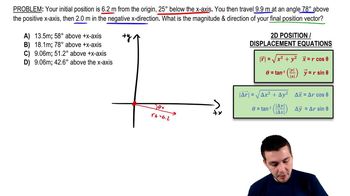
Final Position Vector

Velocity

Velocity is the rate of change of the position vector with respect to time. It is a vector quantity that indicates both the speed and direction of a particle's motion. To find the velocity as a function of time, one must differentiate the position vector with respect to time, yielding a new vector that represents how the position changes over time.
Video consigliato:
Percorso guidato
7:27
Escape Velocity

Differentiation

Differentiation is a fundamental concept in calculus that involves finding the derivative of a function. In physics, it is used to determine rates of change, such as velocity from position. By applying differentiation to the position vector with respect to time, we can derive the expression for velocity, which provides insight into the particle's motion at any given moment.
Video consigliato:
Percorso guidato
13:04
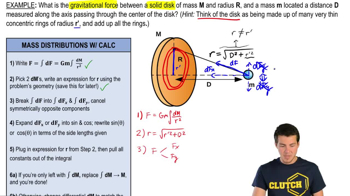
Gravitational Force from a Solid Disk