Ch 03: Vectors and Coordinate Systems
Knight Calc - Physics for Scientists and Engineers 5th Edition
Knight Calc5th EditionPhysics for Scientists and EngineersISBN: 9780137344796Non è quello che usi tu?Cambia libro di testo
Capitolo 3, Problema 31

Ruth sets out to visit her friend Ward, who lives 50 mi north and 100 mi east of her. She starts by driving east, but after 30 mi she comes to a detour that takes her 15 mi south before going east again. She then drives east for 8 mi and runs out of gas, so Ward flies there in his small plane to get her. What is Ward's displacement vector? Give your answer (a) in component form, using a coordinate system in which the y-axis points north, and (b) as a magnitude and direction.

Guida verificata passo dopo passo
1
Step 1: Define the coordinate system. Place Ruth's starting point at the origin (0, 0). The y-axis points north, and the x-axis points east. Ward's location is at (100, 50) in this coordinate system, since he is 100 mi east and 50 mi north of Ruth's starting point.
Step 2: Trace Ruth's path. She first drives 30 mi east, moving her to (30, 0). Then, she takes a detour 15 mi south, moving her to (30, -15). Finally, she drives 8 mi east, ending at (38, -15).
Step 3: Calculate the displacement vector from Ruth's final position to Ward's position. Subtract Ruth's final coordinates from Ward's coordinates: \((x_{Ward} - x_{Ruth}, y_{Ward} - y_{Ruth}) = (100 - 38, 50 - (-15))\).
Step 4: Simplify the displacement vector to component form. The x-component is \(100 - 38\), and the y-component is \(50 - (-15)\). Write the displacement vector as \((\Delta x, \Delta y)\).
Step 5: To find the magnitude and direction of the displacement vector, use the Pythagorean theorem for magnitude: \(\sqrt{(\Delta x)^2 + (\Delta y)^2}\), and use the arctangent function for direction: \(\theta = \tan^{-1}(\Delta y / \Delta x)\). Ensure the angle is measured relative to the positive x-axis.

Risposta video verificata per un problema simile:

Questa soluzione video è stata consigliata dai nostri tutor come utile per risolvere questo problema.
Durata del video:
9m

Concetti chiave

Ecco i concetti essenziali che devi comprendere per rispondere correttamente alla domanda.

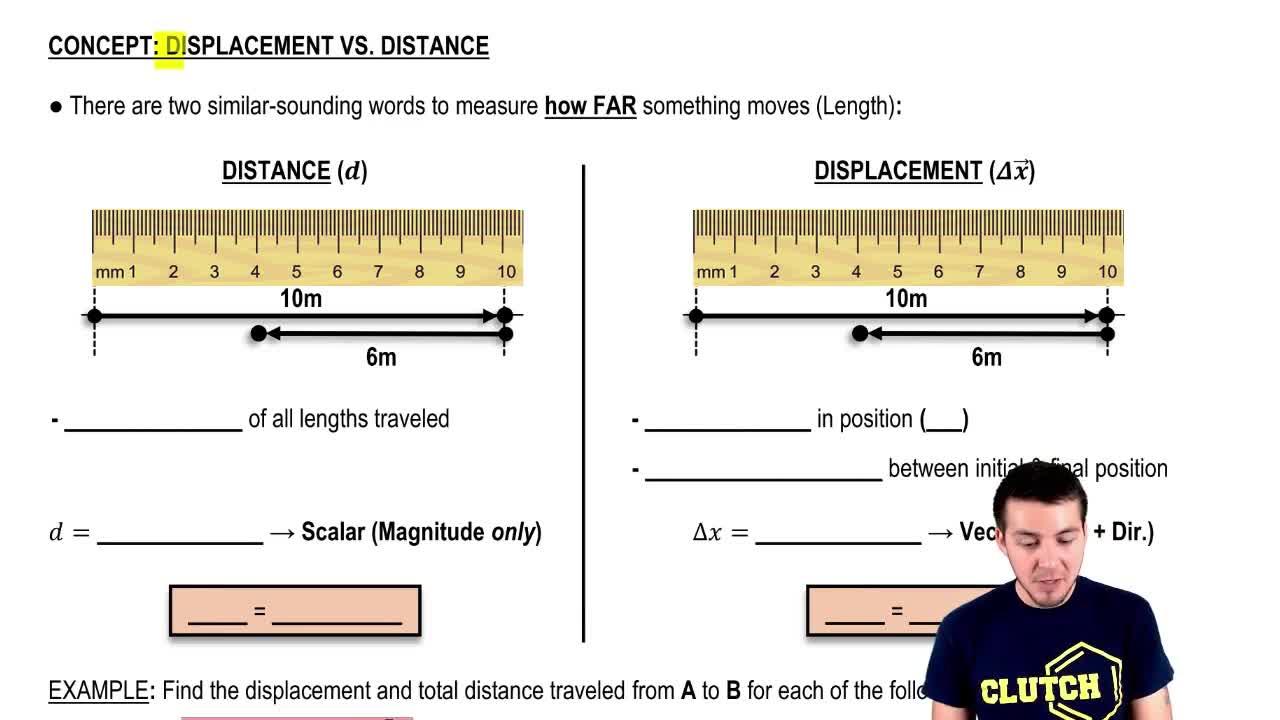
Displacement Vector

A displacement vector represents the change in position of an object from its initial point to its final point. It is defined by both magnitude and direction, indicating how far and in which direction the object has moved. In this scenario, the displacement vector will be calculated based on the coordinates of Ruth's final position relative to her starting point.
Video consigliato:
Percorso guidato
06:13
Displacement vs. Distance

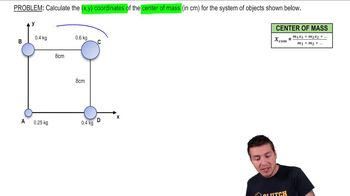
Coordinate System

A coordinate system is a framework used to define the position of points in space. In this problem, a two-dimensional Cartesian coordinate system is employed, where the x-axis represents east-west movement and the y-axis represents north-south movement. Understanding how to translate movements into this system is crucial for accurately determining displacement.
Video consigliato:
Percorso guidato
05:17
Coordinates of Center of Mass of 4 objects

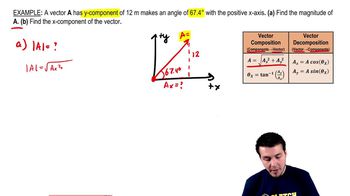
Magnitude and Direction

Magnitude refers to the length or size of a vector, while direction indicates the orientation of that vector in space. For displacement vectors, the magnitude can be calculated using the Pythagorean theorem, and the direction can be expressed as an angle relative to a reference axis. This is essential for providing a complete description of Ward's displacement vector in the problem.
Video consigliato:
Percorso guidato
03:59
Calculating Magnitude & Components of a Vector
Pratica correlata
Domanda del libro di testo

A cannon tilted upward at 30° fires a cannonball with a speed of 100 m/s. What is the component of the cannonball's velocity parallel to the ground?

2194
views

Domanda del libro di testo

While vacationing in the mountains you do some hiking. In the morning, your displacement is Smorning=(2000m,east)+(3000m,north)+(200m,vertical)\(\mathbf{S}\)_{morning} = (2000 \, \(\text{m}\), \(\text{east}\)) + (3000 \, \(\text{m}\), \(\text{north}\)) + (200 \, \(\text{m}\), \(\text{vertical}\)). Continuing on after lunch, your displacement is Safternoon=(1500m,west)+(2000m,north)−(300m,vertical)\(\mathbf{S}\)_{afternoon} = (1500 \, \(\text{m}\), \(\text{west}\)) + (2000 \, \(\text{m}\), \(\text{north}\)) - (300 \, \(\text{m}\), \(\text{vertical}\)). What is the magnitude of your net displacement for the day?

1405
views
Domanda del libro di testo

A cannonball leaves the barrel with velocity v = (75î + 45ĵ). At what angle is the barrel tilted above horizontal?

2273
views
Domanda del libro di testo

Trevon drives with velocity v1 = (55î - 10ĵ) mph for 1.0 h, then v2 = (20î + 50ĵ) mph for 2.0 h. What is Trevon's displacement? Write your answer in component form using unit vectors.

2593
views
Domanda del libro di testo

You are fixing the roof of your house when a hammer breaks loose and slides down. The roof makes an angle of 35° with the horizontal, and the hammer is moving at 4.5 m/s when it reaches the edge. What are the horizontal and vertical components of the hammer's velocity just as it leaves the roof?

2187
views
Domanda del libro di testo

While vacationing in the mountains you do some hiking. In the morning, your displacement is Smorning=(2000m,east)+(3000m,north)+(200m,vertical)\(\mathbf{S}\)_{morning} = (2000 \, \(\text{m}\), \(\text{east}\)) + (3000 \, \(\text{m}\), \(\text{north}\)) + (200 \, \(\text{m}\), \(\text{vertical}\)). Continuing on after lunch, your displacement is Safternoon=(1500m,west)+(2000m,north)−(300m,vertical)\(\mathbf{S}\)_{afternoon} = (1500 \, \(\text{m}\), \(\text{west}\)) + (2000 \, \(\text{m}\), \(\text{north}\)) - (300 \, \(\text{m}\), \(\text{vertical}\)). At the end of the hike, how much higher or lower are you compared to your starting point?

1515
views