Ch 03: Vectors and Coordinate Systems
Knight Calc - Physics for Scientists and Engineers 5th Edition
Knight Calc5th EditionPhysics for Scientists and EngineersISBN: 9780137344796Non è quello che usi tu?Cambia libro di testo
Capitolo 3, Problema 34

You are fixing the roof of your house when a hammer breaks loose and slides down. The roof makes an angle of 35° with the horizontal, and the hammer is moving at 4.5 m/s when it reaches the edge. What are the horizontal and vertical components of the hammer's velocity just as it leaves the roof?

Guida verificata passo dopo passo
1
Step 1: Understand the problem. The hammer is sliding down a roof inclined at an angle of 35° with the horizontal. Its velocity at the edge of the roof is 4.5 m/s. We need to find the horizontal and vertical components of this velocity.
Step 2: Recall the relationship between the components of velocity and the angle of inclination. The horizontal component of velocity (v_x) is given by v_x = v * cos(θ), and the vertical component of velocity (v_y) is given by v_y = v * sin(θ), where v is the magnitude of the velocity and θ is the angle of inclination.
Step 3: Substitute the given values into the formulas. The magnitude of the velocity (v) is 4.5 m/s, and the angle of inclination (θ) is 35°. Use the trigonometric functions cosine and sine to calculate the components.
Step 4: For the horizontal component, use the formula v_x = 4.5 * cos(35°). Ensure that the angle is in degrees if using a calculator or convert to radians if required by your calculation method.
Step 5: For the vertical component, use the formula v_y = 4.5 * sin(35°). Again, ensure the angle is correctly interpreted by your calculation method. These two components represent the hammer's velocity in the horizontal and vertical directions as it leaves the roof.

Risposta video verificata per un problema simile:

Questa soluzione video è stata consigliata dai nostri tutor come utile per risolvere questo problema.
Durata del video:
5m

Concetti chiave

Ecco i concetti essenziali che devi comprendere per rispondere correttamente alla domanda.

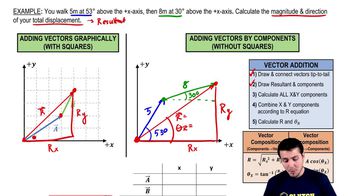
Vector Components

In physics, a vector can be broken down into its horizontal and vertical components. This is essential for analyzing motion in two dimensions. The horizontal component is found by multiplying the vector's magnitude by the cosine of the angle, while the vertical component is found by multiplying by the sine of the angle. This decomposition allows for easier calculations of motion in different directions.
Video consigliato:
Percorso guidato
07:30
Vector Addition By Components

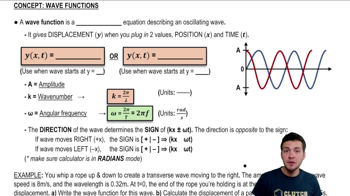
Trigonometric Functions

Trigonometric functions, specifically sine and cosine, relate the angles of a triangle to the ratios of its sides. In this context, they are used to determine the components of the hammer's velocity based on the angle of the roof. For an angle θ, the cosine function gives the adjacent side (horizontal component), and the sine function gives the opposite side (vertical component). Understanding these functions is crucial for solving problems involving angles and motion.
Video consigliato:
Percorso guidato
08:30
Intro to Wave Functions

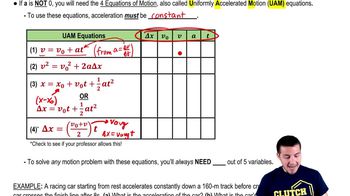
Kinematics

Kinematics is the branch of physics that describes the motion of objects without considering the forces that cause the motion. It involves concepts such as velocity, acceleration, and displacement. In this scenario, kinematics helps us analyze the hammer's motion as it transitions from the roof to free fall, allowing us to calculate its velocity components at the moment it leaves the roof.
Video consigliato:
Percorso guidato
08:25
Kinematics Equations
Pratica correlata
Domanda del libro di testo

Jack and Jill ran up the hill at 3.0 m/s. The horizontal component of Jill's velocity vector was 2.5 m/s. What was the vertical component of Jill's velocity?

1936
views

Domanda del libro di testo

Ruth sets out to visit her friend Ward, who lives 50 mi north and 100 mi east of her. She starts by driving east, but after 30 mi she comes to a detour that takes her 15 mi south before going east again. She then drives east for 8 mi and runs out of gas, so Ward flies there in his small plane to get her. What is Ward's displacement vector? Give your answer (a) in component form, using a coordinate system in which the y-axis points north, and (b) as a magnitude and direction.

2469
views
Domanda del libro di testo

A cannon tilted upward at 30° fires a cannonball with a speed of 100 m/s. What is the component of the cannonball's velocity parallel to the ground?

2194
views
Domanda del libro di testo

Jack and Jill ran up the hill at 3.0 m/s. The horizontal component of Jill's velocity vector was 2.5 m/s. What was the angle of the hill?

1882
views
Domanda del libro di testo

Kami is walking through the airport with her two-wheeled suitcase. The suitcase handle is tilted 40° from vertical, and Kami pulls parallel to the handle with a force of 120 N. (Force is measured in newtons, abbreviated N.) What are the horizontal and vertical components of her applied force?

1768
views
Domanda del libro di testo

A cannonball leaves the barrel with velocity v = (75î + 45ĵ). At what angle is the barrel tilted above horizontal?

2273
views