
Ch 04: Kinematics in Two Dimensions
Knight Calc - Physics for Scientists and Engineers 5th Edition
Knight Calc5th EditionPhysics for Scientists and EngineersISBN: 9780137344796Non è quello che usi tu?Cambia libro di testo
Capitolo 4, Problema 50c

A ball is thrown toward a cliff of height h with a speed of 30 m/s and an angle of 60° above horizontal. It lands on the edge of the cliff 4.0 s later. What is the ball's impact speed?

Guida verificata passo dopo passo
1
Step 1: Break the initial velocity into horizontal and vertical components. Use the equations: \( v_{x0} = v_0 \cos(\theta) \) and \( v_{y0} = v_0 \sin(\theta) \), where \( v_0 = 30 \, \text{m/s} \) and \( \theta = 60^\circ \).
Step 2: Calculate the vertical velocity at the time of impact using the kinematic equation: \( v_y = v_{y0} - g t \), where \( g = 9.8 \, \text{m/s}^2 \) and \( t = 4.0 \, \text{s} \).
Step 3: The horizontal velocity remains constant throughout the motion because there is no horizontal acceleration. Thus, \( v_x = v_{x0} \).
Step 4: Use the Pythagorean theorem to find the magnitude of the impact speed. The total speed is given by \( v = \sqrt{v_x^2 + v_y^2} \).
Step 5: Combine the results from Steps 2 and 3 into the equation from Step 4 to determine the ball's impact speed.

Risposta video verificata per un problema simile:

Questa soluzione video è stata consigliata dai nostri tutor come utile per risolvere questo problema.
Durata del video:
9m

Concetti chiave

Ecco i concetti essenziali che devi comprendere per rispondere correttamente alla domanda.

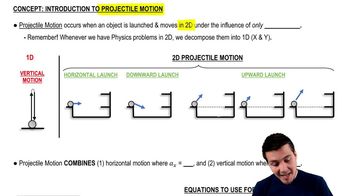
Projectile Motion

Projectile motion refers to the motion of an object that is launched into the air and is subject to gravitational forces. It can be analyzed by breaking it into horizontal and vertical components. The horizontal motion is uniform, while the vertical motion is influenced by gravity, leading to a parabolic trajectory. Understanding these components is essential for calculating the object's position and speed at any point in time.
Video consigliato:
Percorso guidato
04:44
Introduction to Projectile Motion

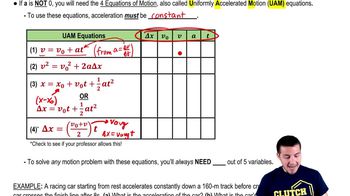
Kinematic Equations

Kinematic equations describe the relationships between an object's displacement, velocity, acceleration, and time. For projectile motion, these equations can be applied separately to the horizontal and vertical components. They allow us to calculate final velocities and positions based on initial conditions and the effects of gravity, which is crucial for determining the impact speed of the ball in this scenario.
Video consigliato:
Percorso guidato
08:25
Kinematics Equations

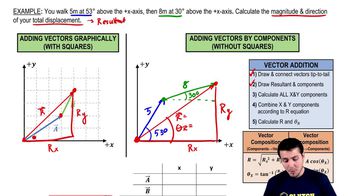
Vector Addition

Vector addition is the process of combining two or more vectors to determine a resultant vector. In the context of projectile motion, the velocity of the ball just before impact can be found by adding its horizontal and vertical velocity components. Since these components are perpendicular to each other, the Pythagorean theorem is used to find the magnitude of the resultant velocity, which represents the ball's impact speed.
Video consigliato:
Percorso guidato
07:30
Vector Addition By Components
Pratica correlata
Domanda del libro di testo

You are watching an archery tournament when you start wondering how fast an arrow is shot from the bow. Remembering your physics, you ask one of the archers to shoot an arrow parallel to the ground. You find the arrow stuck in the ground 60 m away, making a 30° angle with the ground. How fast was the arrow shot?

2499
views
Domanda del libro di testo

A ball is thrown toward a cliff of height h with a speed of 30 m/s and an angle of 60° above horizontal. It lands on the edge of the cliff 4.0 s later. What was the maximum height of the ball?

2639
views
Domanda del libro di testo

You're 6.0 m from one wall of the house seen in FIGURE P4.55. You want to toss a ball to your friend who is 6.0 m from the opposite wall. The throw and catch each occur 1.0 m above the ground. At what angle should you toss the ball?

2096
views
Domanda del libro di testo

A gray kangaroo can bound across level ground with each jump carrying it 10 m from the takeoff point. Typically the kangaroo leaves the ground at a 20° angle. If this is so: What is its maximum height above the ground?

451
views
Domanda del libro di testo

A cannonball is fired at 100 m/s from a barrel tilted upward at 25°. What is the angle after the cannonball travels 500 m?

2370
views
Domanda del libro di testo

A projectile is launched from ground level at angle θ and speed v₀ into a headwind that causes a constant horizontal acceleration of magnitude a opposite the direction of motion. What is the angle for maximum range if a is 10% of g?

2490
views
1
rank