Ch 04: Kinematics in Two Dimensions
Knight Calc - Physics for Scientists and Engineers 5th Edition
Knight Calc5th EditionPhysics for Scientists and EngineersISBN: 9780137344796Non è quello che usi tu?Cambia libro di testo
Capitolo 4, Problema 13a

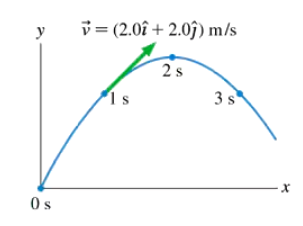
A physics student on Planet Exidor throws a ball, and it follows the parabolic trajectory shown in FIGURE EX4.13. The ball's position is shown at 1 s intervals until t = 3s. At t = 1s, the ball's velocity is v = (2.0 i + 2.0 j) m/s. Determine the ball's velocity at t = 0 s, 2s, and 3s.

Guida verificata passo dopo passo
1
Step 1: Understand the problem. The ball follows a parabolic trajectory, which indicates that it is under the influence of gravity. The velocity at any point can be determined by analyzing the horizontal and vertical components of motion separately. The horizontal velocity remains constant, while the vertical velocity changes due to gravitational acceleration.
Step 2: Break the given velocity at t = 1s into components. The velocity is given as \( \mathbf{v} = (2.0 \mathbf{i} + 2.0 \mathbf{j}) \, \text{m/s} \). Here, \( 2.0 \mathbf{i} \) is the horizontal component \( v_x \), and \( 2.0 \mathbf{j} \) is the vertical component \( v_y \). Note that gravity only affects the vertical component.
Step 3: Use the vertical motion equation to determine the vertical velocity at different times. The equation for vertical velocity is \( v_y = v_{y0} - g t \), where \( v_{y0} \) is the initial vertical velocity, \( g \) is the acceleration due to gravity on Planet Exidor, and \( t \) is the time. At t = 1s, \( v_y = 2.0 \text{ m/s} \). Rearrange the equation to find \( g \): \( g = \frac{v_{y0} - v_y}{t} \).
Step 4: Calculate the velocity at t = 0s, 2s, and 3s. For t = 0s, the velocity is \( \mathbf{v} = v_x \mathbf{i} + v_{y0} \mathbf{j} \). For t = 2s and t = 3s, use the horizontal velocity \( v_x = 2.0 \text{ m/s} \) (constant) and the vertical velocity equation \( v_y = v_{y0} - g t \) to find the vertical components at those times.
Step 5: Combine the horizontal and vertical components to express the velocity as a vector at each time. For example, at t = 2s, \( \mathbf{v} = v_x \mathbf{i} + v_y \mathbf{j} \), where \( v_x = 2.0 \text{ m/s} \) and \( v_y \) is calculated using the vertical motion equation. Repeat this process for t = 3s.

Risposta video verificata per un problema simile:

Questa soluzione video è stata consigliata dai nostri tutor come utile per risolvere questo problema.

Concetti chiave

Ecco i concetti essenziali che devi comprendere per rispondere correttamente alla domanda.

Projectile Motion

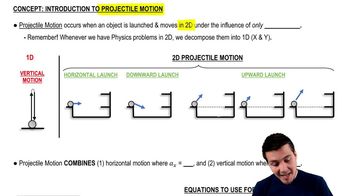
Projectile motion refers to the motion of an object that is thrown or projected into the air, subject to the force of gravity. It follows a curved path known as a parabola, characterized by horizontal and vertical components of motion. The horizontal motion is uniform, while the vertical motion is influenced by gravitational acceleration, typically approximated as 9.81 m/s² downward.
Video consigliato:
Percorso guidato
04:44
Introduction to Projectile Motion

Velocity Vector

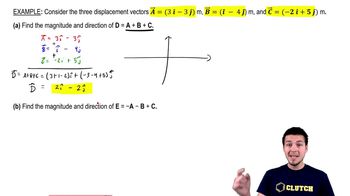
Velocity is a vector quantity that describes the rate of change of an object's position with respect to time, incorporating both speed and direction. In this context, the velocity vector is expressed in terms of its components, such as v = (vx i + vy j) m/s, where 'i' and 'j' represent the horizontal and vertical directions, respectively. Understanding how to decompose and analyze these components is crucial for determining the ball's velocity at different times.
Video consigliato:
Percorso guidato
06:44
Adding 3 Vectors in Unit Vector Notation

Kinematic Equations

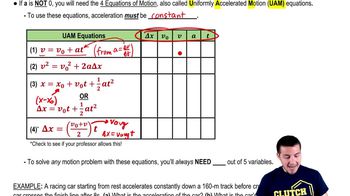
Kinematic equations are mathematical formulas that relate an object's displacement, initial velocity, final velocity, acceleration, and time. These equations are essential for solving problems involving motion, particularly when acceleration is constant, as in projectile motion. By applying these equations, one can calculate the velocity of the ball at various time intervals, given its initial conditions and the effects of gravity.
Video consigliato:
Percorso guidato
08:25
Kinematics Equations
Pratica correlata
Domanda del libro di testo

You have a remote-controlled car that has been programmed to have velocity v=(−3ti+2t2j)m/s\(\mathbf{v}\) = (-3t\(\mathbf{i}\) + 2t^2\(\mathbf{j}\)) \, \(\text{m/s}\), where t is in s. At t = 0 s, the car is at r0=(3.0i+2.0j)m\(\mathbf{r}\)_0 = (3.0\(\mathbf{i}\) + 2.0\(\mathbf{j}\)) \, \(\text{m}\). What are the car's position vector?

1941
views

Domanda del libro di testo

A rifle is aimed horizontally at a target 50 m away. The bullet hits the target 2.0 cm below the aim point. (b) What was the bullet's speed as it left the barrel?

2516
views
Domanda del libro di testo

A particle's trajectory is described by x=(12t3−2t2)mandy=(12t2−2t)m,x = \(\left\)(\(\frac{1}{2}\) t^3 - 2t^2\(\right\)) \, \(\text{m}\) \(\quad\) \(\text{and}\) \(\quad\) y = \(\left\)(\(\frac{1}{2}\) t^2 - 2t\(\right\)) \, \(\text{m}\), where tt is in ss. What is the particle's direction of motion, measured as an angle from the xx-axis, at t=0 st=0\(\text{ s}\) and t=4 st=4\(\text{ s}\)?

403
views
Domanda del libro di testo

A supply plane needs to drop a package of food to scientists working on a glacier in Greenland. The plane flies 100 m above the glacier at a speed of 150 m/s. How far short of the target should it drop the package?

2055
views
Domanda del libro di testo

On the Apollo 14 mission to the moon, astronaut Alan Shepard hit a golf ball with a 6 iron. The free-fall acceleration on the moon is 1/6 of its value on earth. Suppose he hit the ball with a speed of 25 m/s at an angle 30 degrees above the horizontal. For how much more time was the ball in flight?

2247
views
Domanda del libro di testo

A physics student on Planet Exidor throws a ball, and it follows the parabolic trajectory shown in FIGURE EX4.13. The ball's position is shown at 1 s intervals until t = 3s. At t = 1s, the ball's velocity is v = (2.0 i + 2.0 j) m/s. What is the value of g on Planet Exidor?

2625
views