
Ch 04: Kinematics in Two Dimensions
Knight Calc - Physics for Scientists and Engineers 5th Edition
Knight Calc5th EditionPhysics for Scientists and EngineersISBN: 9780137344796Non è quello che usi tu?Cambia libro di testo
Capitolo 4, Problema 17b

On the Apollo 14 mission to the moon, astronaut Alan Shepard hit a golf ball with a 6 iron. The free-fall acceleration on the moon is 1/6 of its value on earth. Suppose he hit the ball with a speed of 25 m/s at an angle 30 degrees above the horizontal. For how much more time was the ball in flight?

Guida verificata passo dopo passo
1
Step 1: Understand the problem. The question asks for the additional time the golf ball was in flight on the moon compared to Earth. The key difference is the free-fall acceleration, which is 1/6 of Earth's gravity on the moon. The initial velocity and launch angle are the same for both cases.
Step 2: Write the formula for the total time of flight for projectile motion. The time of flight is given by: T = 2v0yg, where v0y is the vertical component of the initial velocity and g is the acceleration due to gravity.
Step 3: Calculate the vertical component of the initial velocity. Use the formula: v0y = v0sinθ, where v0 is the initial speed (25 m/s) and θ is the launch angle (30 degrees).
Step 4: Substitute the values of g for Earth and the moon. On Earth, g = 9.8 m/s², and on the moon, g = 9.86 m/s². Use these values to calculate the time of flight for both cases.
Step 5: Find the difference in time of flight. Subtract the time of flight on Earth from the time of flight on the moon: ΔT = Tmoon - Tearth. This will give the additional time the ball was in flight on the moon.

Risposta video verificata per un problema simile:

Questa soluzione video è stata consigliata dai nostri tutor come utile per risolvere questo problema.
Durata del video:
13m

Concetti chiave

Ecco i concetti essenziali che devi comprendere per rispondere correttamente alla domanda.

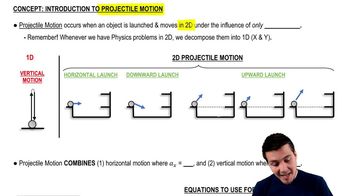
Projectile Motion

Projectile motion refers to the motion of an object that is launched into the air and is subject to gravitational forces. It can be analyzed by breaking it into horizontal and vertical components. The horizontal motion is uniform, while the vertical motion is influenced by gravity, which affects the time of flight and the maximum height reached.
Video consigliato:
Percorso guidato
04:44
Introduction to Projectile Motion

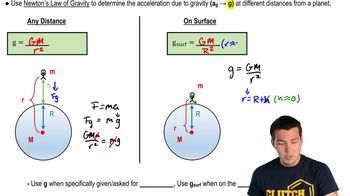
Acceleration due to Gravity

Acceleration due to gravity is the rate at which an object accelerates towards the Earth (or another celestial body) due to gravitational force. On the Moon, this acceleration is approximately 1/6th of that on Earth, which significantly affects the time an object remains in the air when projected. This lower gravity results in a longer flight time for projectiles.
Video consigliato:
Percorso guidato
05:20
Acceleration Due to Gravity

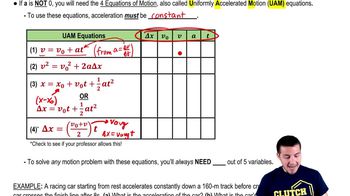
Kinematic Equations

Kinematic equations describe the motion of objects under constant acceleration. They relate displacement, initial velocity, final velocity, acceleration, and time. In the context of projectile motion, these equations can be used to calculate the time of flight, maximum height, and range of the projectile, taking into account the initial speed and launch angle.
Video consigliato:
Percorso guidato
08:25
Kinematics Equations